SUBJECT: AI Training for E-commerce Marketing & Automation

AI Training in E-commerce Marketing - How to Automate Descriptions and Personalize Offers
> Key Takeaways
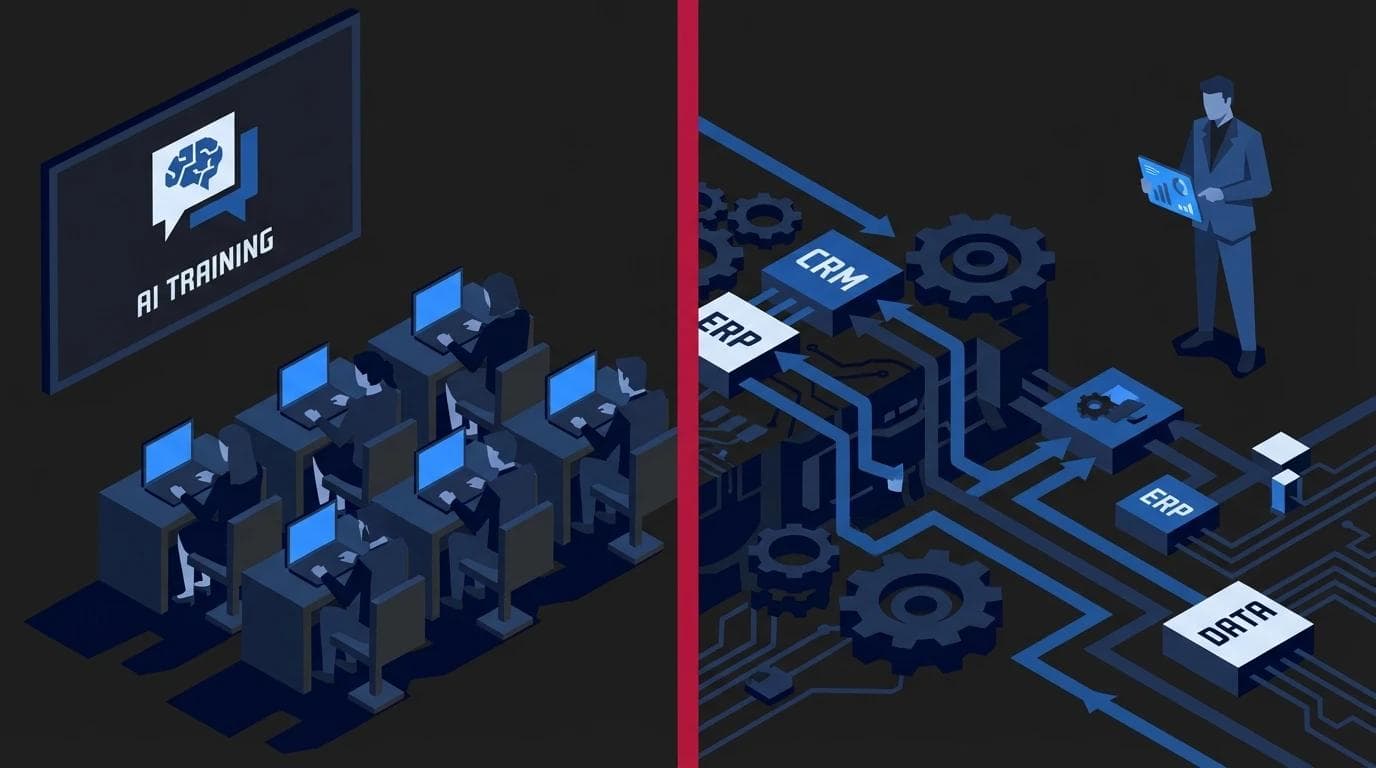
AI training in e-commerce marketing forms the foundation of modern sales strategies, allowing for a drastic reduction in time-to-market and optimization of operational costs. Through intelligent description automation and offer personalization, companies can eliminate the need for armies of external SEO proofreaders while increasing conversion by precisely targeting customer emotions. This approach ensures that professional ai training for business becomes a high-ROI investment rather than just a theoretical course on modern technologies.
Understanding the value provided by ai training for companies requires looking at business through the lens of engineering efficiency. The most important points to grasp are:
- Infinite acceleration of time-to-market - processes established with implementation experts in e-commerce allow for instant updates of massive product catalogs. This eliminates the drain of thousands of dollars previously spent on external agencies copying SEO dictionaries.
- Increased checkout return rates - users buy emotions served on a platter of logic. Highly targeted process automation regarding dynamic store windows drastically increases server-side efficiency, nearly eliminating the problem of empty, abandoned carts.
- Technological independence of the team - proper ai tool training teaches employees how to build their own assistants and scripts, removing the burden of constant supervision over repetitive tasks from management.
- Security and enterprise standards - reliable ai in practice training emphasizes intellectual property protection, preventing corporate data leaks to public language models.
Investing in team education is the first step, but a comprehensive ai implementation in the company determines whether the technology stays with you for the long term. Modern e-commerce development must now include artificial intelligence modules at the architectural design stage to fully exploit the potential of data and automated marketing processes.
> How AI Marketing Training Impacts E-commerce Scaling
AI training in e-commerce marketing is the cornerstone of modern sales scaling because it eliminates the bottleneck of manual content creation, directly translating into higher conversion rates and drastic time savings. By implementing generative language models, a marketing team can produce thousands of unique, SEO-optimized product descriptions and personalize offers for specific customer segments in minutes. In practice, this means moving from reactive operations to proactive market dominance, where every new item in the assortment is immediately visible and attractive to search engines.
For brand owners, the market war in the e-commerce sector operates under intense pressure to introduce inventory into new sales cycles. When data flows from heavy supplier systems, manual information processing regarding margins and product parameters simply cannot keep up with new arrivals, especially after a long work week. This is why ai training for business is designed to lead to a conscious management decision to abandon archaic Excel sheets in favor of intelligent tools that unlock the team's creative potential.
Modern e-commerce development cannot end with the platform itself - it must include a technological layer ready for mass data production. Without proper staff preparation, companies "burn" budgets on mindless rewriting of descriptions from old competitors, which lowers domain value in the eyes of Google. A comprehensive guide to ai training for companies shows how to escape market hype and implement dedicated, invisible data generation automation, saving thousands of hours spent on tedious folder updates.
To see a real return on investment, process automation that connects warehouse systems with AI engines is essential. This symbiosis ensures that descriptions, meta-tags, and technical parameters are generated in the background while specialists focus on strategy and campaign optimization. This engineering approach, rather than just a marketing one, allows for scaling without the need to proportionally increase employment. The consistency of these actions is also confirmed by ai training for b2b sales, where follow-up automation and offer personalization close the digital transformation cycle of a modern enterprise.
> Step-by-Step Product Description Automation - Training Your Team on LLMs
Effective product description automation in e-commerce is not about simply pasting a product name into a chat window. It is a precise engineering process that begins with organizing assortment data and ends with mass content generation via API. For the system to work, the team must learn to build "instruction blocks" that transform raw technical specifications into persuasive benefits-driven language. This is how we design ai training for business, emphasizing real implementation over theoretical discussions about the future.
The first step is input data hygiene. Marketers often work with unreadable XML files from foreign wholesalers or chaotic Excel tables. Our task is to train the team on how to organize these resources in PIM systems so they become "food" for AI assistants. Only when we have clean data can we launch process automation that, without coffee breaks, generates thousands of unique descriptions ready for publication on your site's backend within a few hours.
Preparing Input Data and Prompt Structure
Technical prompt engineering in e-commerce requires moving beyond standard patterns. Instead of asking for a "cool description," we teach the team to define rigid logical rules. A well-constructed prompt must include precise guidelines regarding the brand's Tone of Voice (ToV) and a list of SEO keywords that the AI must naturally weave into the content. This is a critical element that gives e-commerce development a new dynamic - content is not only unique but also optimized for Google algorithms.
During workshops, we demonstrate how to design instructions such as "write in one hundred words an ideal sales argument for a B2C group, based on three dry technical parameters regarding thread pressure, while maintaining an expert tone." This approach is the essence of what our ai in practice training offers. The team learns how to repeat this high-standard cycle for ten thousand new inventory items in a row.
The final stage is quality verification in a human-in-the-loop model. Even the most advanced LLMs require human authorization. Marketers transition from the role of copywriters to the role of editors and quality guardians. Using ai training for companies, we prepare employees to handle the final stage of content publication, where a human eye approves the result produced by machines. This is a safe and scalable path to full digitalization of the product offer without the risk of losing professionalism.
> Shopping Personalization with AI - From Recommendations to Dynamic Content
Shopping personalization using artificial intelligence involves using machine learning models to analyze hard data on user behavior in real-time. Instead of flooding the customer with generic suggestions, these systems dynamically adjust messages, banners, and product sets, eliminating the barrier of decision fatigue and increasing conversion without annoying spam. Forcing too much choice on an e-commerce buyer is a sure way to lose them - out of haste and an excess of options, they abandon the transaction. The solution lies in fast decision models that analyze buyer behavior logic and advise without hesitation on what to push forward before they log out, ensuring the cart does not remain empty.
Contemporary AI training in marketing places huge emphasis on moving from simple scripts to advanced data engineering. In our workshops, we teach how to analyze the backend of vast knowledge from hard numbers to show highly tailored communication. It is not about an approach like "randomly pinned to everything for $15 from an external subscription plugin" - such uninspired solutions are often useless and only irritate buyers. Professional ai training for business shows how to build proprietary recommendation systems that actually increase margins.
When designing a strategy for e-commerce development, it is worth focusing on three pillars of intelligent personalization:
- Associative recommendations (bundle packs) - algorithms identify product sets frequently found together in carts, preventing customers from fleeing to competitors in search of missing offer elements.
- Authentically targeted banners - dynamic graphic content that changes based on previous user interactions, instead of displaying the same promotion to every visitor.
- Time-dedicated reminders - invoicing and communication automation is one thing, but process automation allows for building logic that sends non-spam notifications exactly when the customer needs them.
Such AI implementation in a company allows not only for better handling of current traffic but also generates measurable AI ROI in business. When the marketing team knows how to use analytical tools, they stop guessing and start designing shopping experiences. As our comprehensive guide to ai training for companies emphasizes, understanding personalization mechanisms is essential for ai training for b2b sales to bring the expected results in the form of higher order value and customer loyalty.
> Why AI Training is More Important Than Buying Ready-Made Plugins
Most e-commerce owners fall into the trap of apparent convenience by choosing ready-made "Smart plugins" based on a monthly subscription fee. While they promise instant AI implementation, they actually impose a ruthless "scale tax" on your business. Flat-rate mechanisms or commissions on traffic mean that even when selling small products with low margins, the technology consumes a significant portion of your profit. True ai training for companies teaches how to recognize this economic weight and shows how to avoid dependence on external, closed providers.
Educating the team in AI allows them to understand that instead of paying for "renting air," they can invest in proprietary solutions. By applying an engineering approach, we bypass hidden costs by implementing dedicated and isolated integration scripts that are fully tailored for high-performance e-commerce development. Knowledge gained during ai marketing training gives the team agency - you stop being just interface users and become architects of your own processes.
The advantage of the engineering model over the plugin model manifests in three key areas:
- Full code ownership - unlike closed SaaS systems, dedicated solutions allow for unlimited scaling without increasing licensing costs at the peak of the sales season.
- AI data security - ready-made plugins often send sensitive information about your customers to foreign servers, while proprietary custom applications provide 100% control over where and how data is processed.
- No technological ceiling - understanding how models work allows for a smooth ai implementation in the company that will not break with the first store engine update, as scripts are written according to the highest clean code standards.
For management, ai training for managers is crucial, shifting the perspective from buying ready-made tools to building lasting technological assets. Instead of spending the budget on another subscription, it is better to invest in ai training for business that teaches employees how to independently design process automation. As a result, the company gains unlocked scaling potential and becomes resistant to price changes from mass software providers. Knowing how AI actually works is the best insurance policy for modern e-commerce.
> Practical Techniques for Scaling Content Without Losing SEO Quality
Effective content scaling with artificial intelligence is not a matter of mass-copying answers from a chat window. To avoid Google penalties for so-called thin content, one must move to the engineering level, where process automation based on APIs and environments like n8n play a key role. Pushing out massive blocks of identical paragraph walls to stores is a direct path to a painful red card from algorithms. Instead, professional ai training for business teaches marketing teams how to use models through advanced technical environments to generate 100% unique informational code.
The foundation of maintaining high SEO quality is technical precision. By using rigorous assistants on the API, we can force the model to output content already formatted in a clean HTML schema, containing technical tables, bulleted lists, and semantic headers. This approach eliminates unwanted gibberish and boring filler sentences about equipment, which usually result in massive traffic drops. In e-commerce, where e-commerce development requires thousands of unique descriptions, the only effective way is high-volume work with high unique informational value, realized without operational effort thanks to appropriate scripts.
While standard courses focus on simple commands, substantive ai in practice training shows how to implement processes where AI analyzes a product's technical specification and builds a text about the real advantages of the assortment based on it. Remember that even the best content will not work if the foundation is not efficient website development optimized for Core Web Vitals. Only the combination of a reliable ai implementation in the company with technical architecture allows for marketing scaling while maintaining expert status in the eyes of search engines. You can read more about the strategic approach to these technologies in our article ai training for companies - a guide, which serves as a complete compendium of knowledge for modern enterprises.
> Frequently Asked Questions About AI Training in Online Retail
AI-generated content in e-commerce generates as much enthusiasm as it does concern about Google ranking stability. The truth is that AI does not replace an engineering approach to SEO but becomes a performance catalyst for those who know how to manage it. Below we answer the most pressing questions regarding the implementation of these technologies in the daily work of marketing departments.
Are AI product descriptions safe for Google ranking?
Yes, as long as you do not treat AI as a mindless text factory but as a tool supporting substantive content. Google officially rewards high-quality content (E-E-A-T), not the method of its production. The key is understanding that wholesale generation of descriptions on models will not replace a dedicated expert, as algorithms do not invent logic based on unique consumer intent. Models work perfectly only when professional ai marketing training teaches your team how to create a rigid, excellent operational skeleton from external data. Instead of tedious writing from scratch, the marketer takes on the role of an architect issuing logic to machines, which is the foundation on which we build safe and scalable e-commerce development.
How long does it take to train a marketing team to use AI?
Implementation time depends on the company's current digital maturity, but real effects are visible after the first workshop. A comprehensive ai training for companies guide usually assumes a cycle of 1-3 intensive meetings, after which the team stops wasting dozens of days formatting files and starts implementing ready-made scripts. The work gains enormous substantive significance because the health and time savings in tedious data entry allow for a focus on strategy. To maintain this state, it is worth considering advanced process automation that permanently integrates machine efficiency with your operational servers, turning routine into pure profit.
Which AI tools work best in e-commerce?
Currently, GPT-4o and Claude 3.5 Sonnet are unrivaled in terms of quality, but their potential grows only after connecting with the company's internal systems. Using free versions is often a mistake, which is why we emphasize ai security in the company through the use of APIs and closed environments. In more complicated cases where ready-made solutions are not enough, custom applications work best. They allow for secure processing of price lists and data without the risk of intellectual property leaking into public training sets, as confirmed by our specialized ai training for finance and accounting conducted for sectors with increased data protection requirements.