SUBJECT: Secure ChatGPT Alternatives and AI Training for Business
Secure alternatives to free ChatGPT and Enterprise-grade AI training for companies
> Why free ChatGPT is a risk for companies and what are the secure Enterprise alternatives
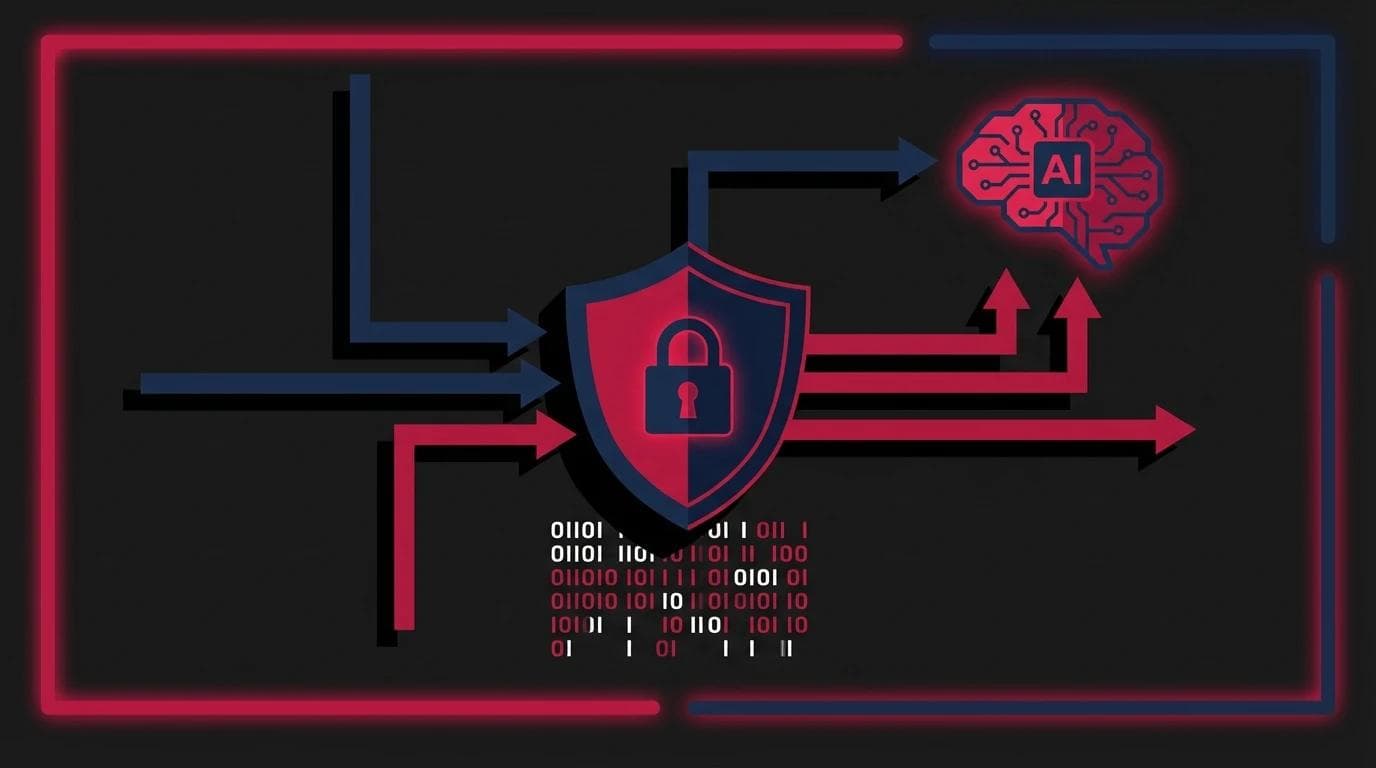
Using the free version of ChatGPT in a business environment involves a critical risk of intellectual property leakage, as data entered into public models is used by default to train them. Corporate data security requires a transition to Enterprise-grade solutions, such as ChatGPT Team, Enterprise, or Microsoft Copilot, which guarantee full isolation of information from machine learning processes. Professional AI training for companies allows teams to understand these differences and implement tools in a manner compliant with GDPR and trade secret protection.
The foundation of working with tools from Silicon Valley is the concept of Data Training. In the case of free assistant variations, every query becomes fuel for future AI versions. If you force a free bot to edit critical source code of your unique platform, you are literally "giving it to the world for free". This phenomenon, referred to as AI security in the company, becomes a real threat to competitive advantage, as your proprietary algorithms can feed the knowledge base available to every user on the planet.
The solution lies in Enterprise-grade environments where we onboard clients using dedicated API authorization keys. In such an architecture, signed terms and conditions ensure that your logic is sent to the so-called digital trash can a fraction of a second after providing an answer, isolating corporate know-how from external servers. By investing in AI training for business, you are technically paying for a market barrier and the certainty that data remains within the organization.
Secure alternatives to free tools include:
- ChatGPT Team and Enterprise - dedicated subscriptions from OpenAI that provide an administrative panel for access management and a guarantee that data is not used to improve models.
- Microsoft Copilot for Business - integrated with the Office 365 ecosystem, offering Enterprise Data Protection, which is crucial for companies relying on Microsoft technology.
- Claude for Business (Anthropic) - a model valued for its high ethical and security standards, ideal for analyzing extensive documentation without the risk of making it public.
- Custom API gateways - when ready-made panels are not enough, we build dedicated applications that connect directly to language models while maintaining restrictive data retention policies.
The choice of the appropriate cooperation model should be preceded by a strategic analysis, which is often covered by AI training for operational managers. These allow for designing processes so that technology realistically supports process automation, instead of generating new legal and operational risks.
> Comparison of AI tools for business - Microsoft Copilot, ChatGPT Team, and Claude Enterprise
The choice between Microsoft Copilot, ChatGPT Team, and Claude Enterprise depends on the company's operational priorities: Copilot offers the deepest integration with the Office 365 ecosystem, ChatGPT Team dominates in creativity and flexibility in building agents, and Claude Enterprise is unrivaled in precise work with massive text documents. All these solutions guarantee full data isolation, which excludes the use of confidential company information for training public AI models.
While free versions carry the risk of intellectual property leakage, professional AI training for companies focuses on the optimal use of the unique advantages of each of these players:
- Microsoft Copilot - this is the solution for organizations that want AI to "see" their calendars, emails in Outlook, and file structure on SharePoint. This allows for instant summarization of Teams meetings or generating document drafts directly in the work environment.
- ChatGPT Team - works best in teams focused on versatility and creating their own assistants (Custom GPTs). The ability to build specialized tools trained on internal instructions is an element we often discuss while conducting AI tool training for various departments.
- Claude Enterprise - an engineering favorite where flawless data analysis matters. Its phenomenal, massive "context window" allows for reviewing the complexities of a complicated, 300-page audit file in a dozen seconds. Other commercial models simply get a troublesome hiccup at such moments when dumping data, losing the thread in the middle of the document.
Selecting a specific model is the foundation of digital transformation. As engineers, however, we notice that only combining these systems with external databases allows for full process automation, eliminating human errors. In situations where standard interfaces are not enough, the solution lies in dedicated applications that integrate selected AI models directly into the company's business logic. For all this to work coherently, substantive AI training for business is necessary to prepare employees for secure cooperation with these advanced technologies.
It is worth remembering that each player offers strong isolation of hard data, but implementation details determine which operating system our engineering support recommends. Claude can process huge attachments in large text files much faster and more analytically, making it an ideal tool for legal and analytical departments, while Copilot remains unrivaled in daily office administration.
> Data ownership and no model training - the foundations of secure AI implementation
Secure implementation of artificial intelligence in an enterprise requires a categorical transition from consumer tools to Enterprise-grade solutions. The key factor here is the guarantee that entered data will not be used to improve public algorithms, which is the only way to fully protect trade secrets and ensure compliance with the upcoming AI Act. Professional AI training for business focuses precisely on configuring these secure environments, eliminating the risk of intellectual property leakage.
A serious threat to organizations is the phenomenon of Shadow AI, i.e., uncontrolled use of free tools by employees, which often generates hidden costs and AI security risks in the company. In an engineering approach, the data ownership model must be treated in two ways. The first pillar is hard On-Premise infrastructure, where dedicated systems responsible for connections between various systems on legacy databases can be located entirely inside the client's physical office building. Thanks to this, sensitive records from ERP or CRM systems never leave the local network in an unprocessed form.
The second pillar is information sovereignty realized through encrypted and authorized connections. Going "outside" to the machines of giants with powerful, locally unattainable computing power occurs only under conditions of full encryption. In such an arrangement, data sent for analysis is treated as ephemeral - the model processes it in real time and does not save it in its knowledge base. This is why ChatGPT training for business places such high emphasis on using API protocols instead of public chat interfaces.
Foundations of a secure AI architecture include:
- No training data retention - Enterprise-grade models have a hard provision in the contract (SLA) that prohibits using your prompts to teach future versions of GPT or Claude.
- Bank-grade encryption - data transmission takes place through secured TLS tunnels, making it impossible for third parties to intercept it.
- Access control and auditability - full insight into who, when, and for what purpose used AI resources in the company.
Understanding these technical aspects allows for actually increasing team efficiency without exposing the organization to image or legal losses. For companies looking for deeper optimization, a good direction is process automation, which integrates secure AI models directly into daily work tools.
> How professional ChatGPT training for business eliminates Shadow AI
Professional ChatGPT training for business eliminates Shadow AI by replacing uncontrolled use of free tools with secure, corporate work standards. Instead of employees hiding the use of assistants on private phones, the organization receives a transparent system and a team capable of operating models in a closed environment. This approach ensures that artificial intelligence stops being a risky "shortcut" on the edge of the terms of service and becomes a measurable asset supported by AI training for business.
The Shadow AI phenomenon most often results from the need for efficiency that official IT infrastructure fails to satisfy. Employees, wanting to work faster, often use mobile phones to hide the fact of using an assistant in free, public models from the company's administration. This leads to serious gaps, as AI security in the company is compromised by the lack of control over output data and the risk of training models on sensitive information. Only opening a hard, but absolutely secure internal panel eliminates the instincts of this "digital maneuvering".
Effective AI training from scratch makes teams aware that a dedicated corporate assistant that perfectly knows specific company procedures performs operations 10 times better than a "hallucinating free shortcut". Implementing professional standards brings specific benefits:
- Elimination of legal risk - employees learn what data must not be entered into models and why public ChatGPT is an experimental tool only.
- Increase in result quality - dedicated systems, including dedicated applications integrated with their own knowledge base, do not hallucinate as often as publicly available chats.
- Work time optimization - instead of manually correcting AI errors, the team uses AI training in business to design repeatable, proven instructions.
- Managerial transparency - thanks to AI training for managers, executive staff can see where AI realistically accelerates processes and where process automation is required.
Transitioning from the Shadow AI phase to managed implementation is the most important step in building a technological advantage. A complete guide to AI training for companies indicates that education must go hand in hand with providing Enterprise-grade tools so that employees do not have to seek help from unsecured external sources.
> From education to automation - how to combine training with real process implementation
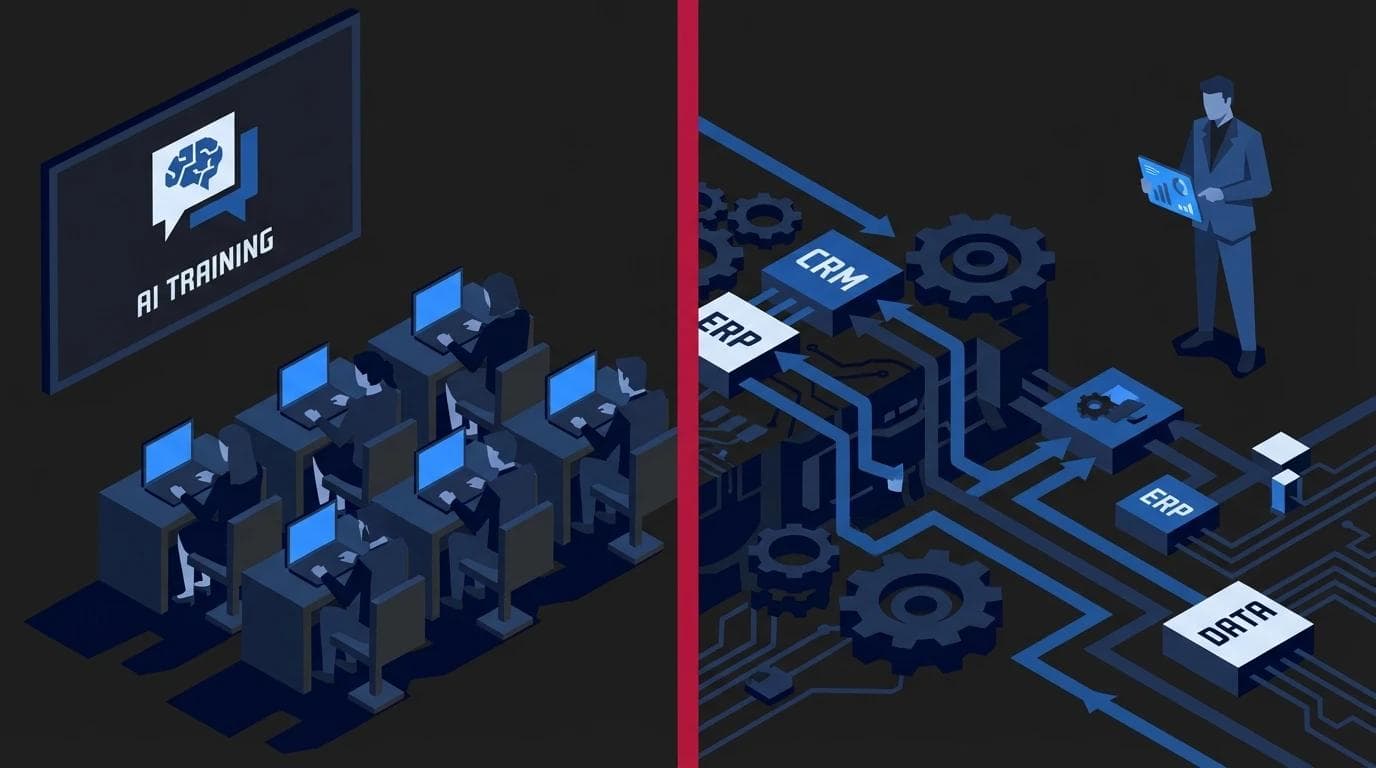
True digital transformation does not end with an employee being able to write a good prompt. This is just the first step, which we call the stage of getting familiar with technology. At 01tech, we believe that engineering success comes when, after solid AI training from scratch, the team stops treating artificial intelligence as a curiosity and starts seeing it as a permanent element of the company's infrastructure.
The evolution from education to full implementation usually proceeds in three key phases:
- Building foundations - learning how to securely use language models in daily tasks, such as drafting emails or analyzing notes. At this stage, AI training for business is crucial, as it eliminates errors in handling sensitive data and builds a data-driven work culture.
- Creating assistants - employees learn to build their own assistants (Custom GPTs) that know company procedures and support them in repeatable decision-making processes using an internal knowledge base.
- Invisible automation - this is the moment when a human stops manually opening the chat interface. Instead, wisely designed process automations based on platforms like self-hosted n8n and Python scripts connect directly to model APIs.
In engineering practice, we strive for a situation where an information flow approved in a procedure runs discreetly in the background. Imagine downloading data from an older, "ugly" financial program, which is then processed by a "smart and hard" machine, and then delivered to the employee in the morning as a clean, generated file directly in their main communicator. Such a digitalization strategy makes AI a silent back-office worker, rather than another tab in the browser that distracts from tasks requiring human creativity.
If processes in your company are too complex for simple scripts, the next natural step is dedicated applications. They allow for wrapping intelligent engines in proprietary interfaces, giving the board full control over business logic and Enterprise-grade code security, without the risk of intellectual property leakage.
> Frequently asked questions about secure AI tools and employee training
Implementing artificial intelligence in an organization raises many questions about privacy, return on investment, and technology selection. It is crucial to understand that secure AI training for business is not just about learning to write prompts, but primarily about education in corporate data hygiene. A professional approach to this topic is explained in our AI training for companies guide, which discusses digital transformation in detail without risk to intellectual property.
Does free ChatGPT really use my data for learning?
Yes, in the default settings of the free version of ChatGPT (Personal), OpenAI reserves the right to use conversations to train its models. This is the main source of the threat defined as AI security in the company, as employees may unknowingly upload confidential source codes, procedures, or client data. Although there is an option to disable training in the settings, only paid business plans provide a corporate guarantee of privacy. It is worth noting that professional systems push very highly structured queries to external analytical environments (only amounts and values, without dictionaries linked to your competition), which makes this cluster of data one hundred percent secured.
What is the difference between ChatGPT Team and the Enterprise version?
ChatGPT Team is designed for smaller and medium-sized teams (from 2 people), offering a shared workspace and a guarantee that data does not train the model. The Enterprise version is a solution for large organizations that need advanced analytics, SSO login, and unlimited access to the fastest models. Importantly for boards, clauses in Enterprise exclude so-called employee interference at the service provider, meaning data is protected from physical inspection by third parties. If your company needs specific integrations, dedicated applications based on closed API models often prove to be a safer choice than public chats. You can learn more about these technical differences from the study ChatGPT public vs Enterprise differences.
Which AI training should I choose for a non-technical team?
For marketing, HR, or administration departments, workshops focused on AI tool training in daily practice are key. Instead of theoretical lectures on the history of technology, the team should focus on Enterprise-type solutions that realistically relieve them of routine tasks. Depending on the nature of the work, we recommend:
- Sales departments - focus on AI training in business and offer personalization.
- Office departments - practical AI training in administration facilitating documentation management.
- Managers - learning process automation using intelligent scripts.
Appropriately selected AI training from scratch allows for breaking employee resistance and showing that artificial intelligence is a support that eliminates tedious table filling in favor of creative thinking.