SUBJECT: AI Training for Manufacturing - Computer Vision & Quality
AI Training for Manufacturing Companies - Using Computer Vision for Quality Control
> Key Takeaways
Investing in professional AI training for manufacturing companies is currently the fastest route to securing margins and eliminating human error on assembly lines. In the world of modern industry, artificial intelligence is not just a chatbot but the foundation of vision systems and IoT, allowing technical staff to manage process deviations in real time. Through proper team education, traditional quality control based on a worker's eyesight is replaced by infallible machines using light-stream verification, which drastically reduces returns and boosts the operational efficiency of the entire plant.
Most Important Aspects of AI Implementation in Production
- Eliminating visual errors through machine vision - a traditional quality controller naturally misses errors after several hours on the floor. Through szkolenia ai od podstaw the team learns to operate intelligent systems for which an error during light-stream verification is a hardware impossibility.
- Direct protection of margin and profit - backend vision systems effectively cut the problem of defective goods leaving the factory. This approach protects the company from costly claims, demonstrating real ai w biznesie roi and allowing for a faster return on technology investment.
- Remote supervision of industrial processes - implementing iot i hardware solutions at workstations enables a qualified team to monitor and correct production deviations without the need for constant physical presence at the machine.
- Data security and AI Act compliance - reliable szkolenia ai dla managerów prepare management to safely implement Enterprise-class tools, protecting the company's intellectual property from uncontrolled data leaks to public models.
- Ending market hype in favor of engineering - effective szkolenia ai dla firm focus on practical applications, such as reporting automation or intelligent warehouse management, moving away from theoretical visions of the future.
> Why AI Training for Manufacturing Companies is the Foundation of Modern Quality Control?
AI training for manufacturing companies forms the foundation of modern quality control because it integrates Computer Vision technology into daily floor operations. It allows technical teams to move from subjective human visual assessment to mathematically precise verification of every detail in real time. This makes it possible to detect microscopic defects with accuracy unachievable by the human eye, directly translating into waste minimization and massive raw material savings.
A modern production network is not about following a point-by-point checklist with a screwdriver for a simple, imprecise, and outdated shape assessment. A modern backend network designed by 01tech analyzes anomalies based on thousands of uploaded defect photos from years of verification in the blink of an eye, "seeing" if a new production variant has even a hundredth of a millimeter of color deviation. Our engineers allow the line team to quickly implement a sensitive and absolutely flawless reading network to save wasted batches of equipment even before palletization starts in a large warehouse. This is precisely why szkolenia AI dla biznesu focus on the practical use of data rather than just theory.
Implementing intelligent vision systems requires a holistic approach to technology:
- Visual data analysis - systems learn to recognize correctness patterns based on historical databases.
- Hardware integration - precision sensors and cameras must communicate seamlessly with the software layer, provided by properly selected iot i hardware.
- Real-time monitoring - error information reaches the operator immediately, allowing the line to be stopped before a costly defect is produced.
For these processes to work coherently, aplikacje dedykowane are often necessary to link AI logic with existing ERP or MES systems in the plant. Such a solution ensures that automatyzacje procesow become a real tool supporting profitability rather than just a technological curiosity. A comprehensive szkolenia ai dla firm - przewodnik shows that the key to success is not just the tool itself, but primarily the team's awareness of how to operate and continuously optimize it.
> How Computer Vision Works in the World of Production Engineering?
Computer Vision in industry has undergone a fundamental paradigm shift. Older mechanized machines, equipped with traditional vision systems, only read what their gaze was rigidly directed at in millimeters. A programmer had to manually define every parameter: from dimension tolerance to contrast levels. This rigidity meant that even a slight change in hall lighting or a minor component shift on the belt generated false alerts, paralyzing the work rhythm.
Modern systems based on neural networks work differently - they learn through associations and deep context, operating on structured local servers with enormous computing power. Instead of comparing an image to a rigid matrix, AI analyzes averaged patterns and physical logic. This is why szkolenia AI od podstaw place such heavy emphasis on understanding the difference between a decision algorithm and a learning model. In engineering practice, this means that if a client's manufactured assortment does not have a specific defect uploaded in memory, but the vision recognizes an anomaly in the texture based on millions of learned material fracture rules - the system will react immediately.
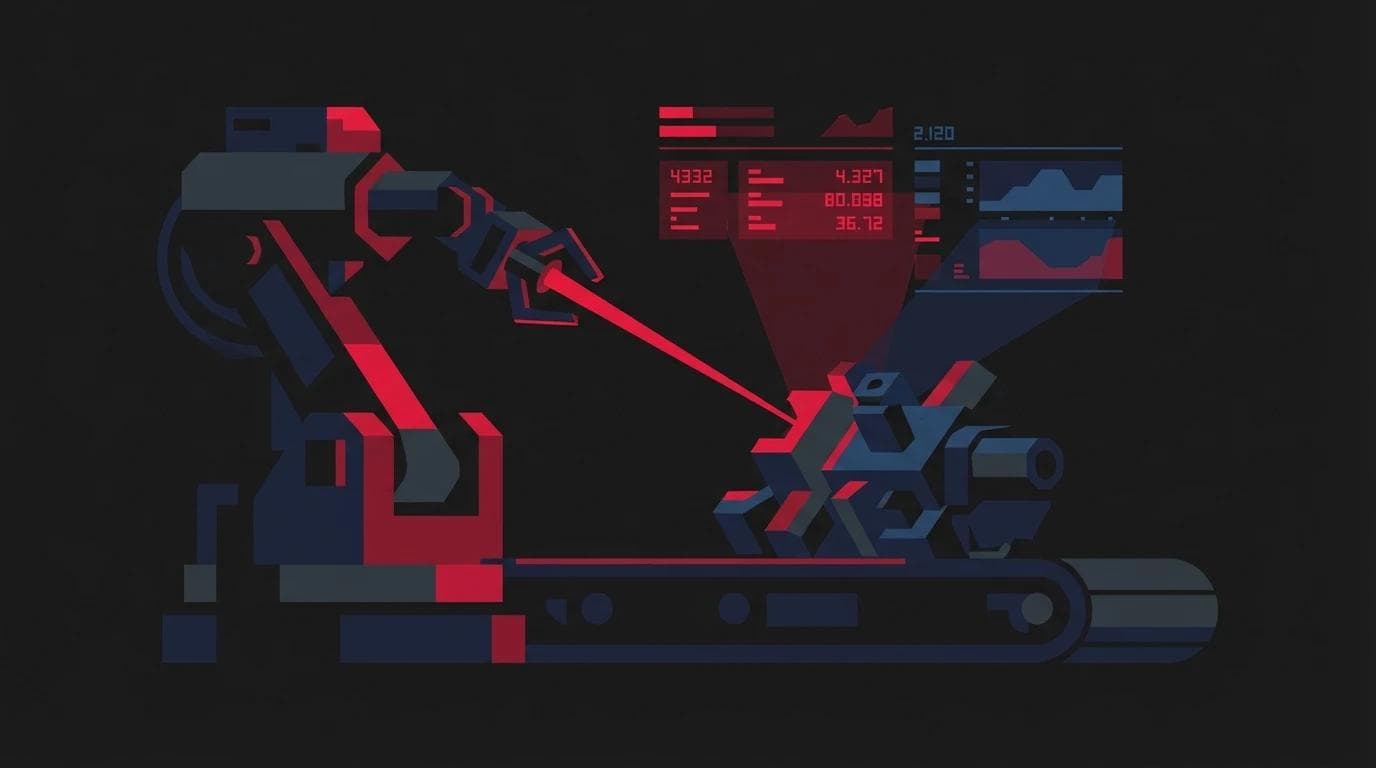
Integrating such technology with the machine park allows for the creation of an autonomous control loop. When an AI model detects a flaw directly on the belt, it can automatically disconnect the defective element and simultaneously send a diagnostic signal to machine technicians. For such a system to work flawlessly, aplikacje dedykowane are essential to link the vision layer with the company's business logic and MES or ERP systems. Directly translating images into operational data ensures that automatyzacje procesow stop being just a slogan and become a real tool for reducing waste costs.
Understanding these mechanisms is crucial for management. In our szkoleniach AI dla biznesu we show how to avoid errors during the training data collection stage, which is a foundation in professional szkoleniach AI dla firm. A properly trained team can independently supervise the network's retraining process, eliminating the need to constantly call external service technicians for every new production assortment.
> Implementing AI Vision Step by Step - A Guide for Managers and Engineers
Implementing vision systems in industry is not a classic IT project - it is a complex engineering task where machine construction forms the foundation. For the system to truly relieve quality control, the entire process must include szkolenia AI od podstaw, preparing staff for a new supervisory role. Instead of looking for off-the-shelf software, we focus on creating an environment capable of making an autonomous decision about a product's fate in real time.
Step 1 - Data Set Preparation and Labeling
The first and most important step is feeding the model a massive portion of photographic information reflecting real hall conditions. In computer vision projects, so-called "dirty data" is crucial - photos showing not just perfect specimens, but primarily dents from previous decades, stains, streaks, or standard deviations that are almost invisible to the human eye. Labeling involves precisely marking these defects, which requires close cooperation between engineers and quality technicians.
For system effectiveness, it is vital that the model is trained in an isolated environment but fed with data directly from the line. Proper image base preparation determines whether the algorithm will be able to distinguish a harmless smudge from a critical crack. At this stage, it often turns out that dedicated iot i hardware solutions are necessary, such as specialized strobe lighting or high-refresh-rate cameras that freeze the movement of speeding parts.
Step 2 - Model Architecture Selection and Training Process
Once we have a reliable data set, we move to the neural network training process. The choice of architecture depends on the required speed and precision - in mass production, we build the process in the heart of the machine, which must decide on a waste verdict after a nanosecond of digital processing. This requires enormous computing power during the learning phase (GPU), but the inference itself - the model's live operation - often takes place on edge devices (Edge AI) directly at the line.
Technical model training is not everything, however. Simultaneously, we implement a hard security protocol in the company, training the human controller to be a technical alert verifier. The human stops being the executor of a tedious review and becomes a system auditor. This approach is promoted by our przewodnik po szkoleniach AI, indicating that technology is a safe tool only when the team understands the mechanics of its errors. Effective szkolenia AI dla biznesu allow avoiding the risk of over-reliance on the algorithm, which is crucial in industries with high technical rigor, creating fully functional aplikacje dedykowane for quality management.
> Integrating AI Vision with IoT and Hardware Infrastructure
Image analysis by algorithms alone is only half the battle in a modern factory. True value appears when intelligent readings stop being "trapped" inside the processor and are linked with the environment and steel. At 01tech, we believe that bringing production halls to life involves overlaying sensors, which we call the "bits to atoms" philosophy. Thanks to this, even an older machine park can become part of an intelligent ecosystem, which we often discuss while conducting szkolenia ai dla managerów responsible for plant modernization.
This process begins with the physical data acquisition layer - industrial cameras and precision lighting - and ends with direct interaction with PLC (Programmable Logic Controller) units. When the computer notices a defect on the line, the signal from the server side instantly reaches the heavy-duty controller. Then, the conveyor arm independently diverts the bad product to a service track, while the technical operator drinks a warm coffee without haste or the intense stress resulting from production loss that could occur after years of working in fatigue. This is why comprehensive szkolenia ai dla firm place such high emphasis on the practical connection of software with the machine park.
Integrating computer vision with iot i hardware infrastructure requires a precise engineering approach in three areas:
- Vision layer stability - we use dedicated strobe lighting to eliminate the influence of daylight, which is crucial when conducting szkolenia z narzedzi ai for technical teams.
- M2M (Machine-to-Machine) communication - we utilize protocols such as MQTT or Modbus so the AI system can "talk" to machines in real time.
- Edge Computing - we process data directly at the production line to minimize latency and ensure work continuity even without a stable internet connection.
For companies seeking real benefits, ai w biznesie roi becomes measurable in the fractions of seconds saved on automation reaction. Often in such scenarios, aplikacje dedykowane are necessary to serve as the central operational brain, aggregating data from sensors and cameras. If your goal is full transformation, szkolenia ai dla biznesu will help the team understand how to independently supervise these systems. Remember that every automatyzacja procesow based on hardware must be preceded by a reliable audit so that bits and atoms harmonize flawlessly.
> Measurable Benefits and ROI - How AI Training Translates into Profit?
Return on investment (ROI) in AI training for manufacturing companies manifests primarily in a drastic reduction of error costs and optimization of resource utilization that previously generated hidden losses. Real profits appear as early as the first quarter after implementation, mainly due to the elimination of human middleware in control processes and precise management of energy and raw materials. Effective szkolenia AI dla biznesu allow engineering staff to independently identify bottlenecks, which directly translates into the profitability of the entire supply chain. In floor processes, lost production time, wasted electricity from drives, or used material alloys without the possibility of quick, effective replacement for casting are daily realities that destroy margins without algorithm support. The final and painful loss of good reputation due to a massive return from the entire supply chain, from the store to the distribution center, can reduce a company's capital for years. A good and sharp mechanized arm supported by a precisely implemented system is a lethal investment effectiveness. After the technological payout, the environment returns full cost amortization without a night break, making automatyzacje procesow the foundation of a modern factory. Measurable benefits from AI implementation include several key areas:
- Reduction of claims and returns costs - AI vision systems, which employees learn to operate during workshops, detect micro-defects invisible to the human eye. Quality consistency builds trust with wholesale recipients, eliminating contractual penalties for defective batches.
- Minimization of material waste - algorithms trained on data from IoT i hardware can correct machine parameters in advance, preventing the creation of defects. This saves raw materials, the prices of which in heavy industry constitute the lion's share of variable costs.
- Optimization of controller work time - AI does not replace humans but takes over the boring, repetitive analysis of thousands of product units. Quality controllers, thanks to knowing jak mierzyc ROI ze szkolenia AI, can focus on process optimization instead of mechanical detail checking. Understanding these mechanisms is crucial, as mentioned in every comprehensive szkolenia AI dla firm przewodnik, because technology without a prepared team remains a dead cost. By investing in education, a company buys a tool that doesn't need sleep, doesn't get sick, and learns every day how to generate greater savings for the plant.
> Frequently Asked Questions about AI Training for Production
Implementing advanced algorithms on the production floor is a process that requires clearing technical doubts before the first click in the code. Companies often worry about technology stability in harsh industrial conditions and the security of operational data.
Do AI vision systems require a constant internet connection?
A key solution for industry is so-called Edge AI, which means processing data directly on local devices. Thanks to this, vision systems do not require a constant cloud connection, guaranteeing lightning-fast reaction times and full data sovereignty. In practice, this means that even during an external network failure, your quality control works without interruption. At 01tech, we design such solutions by combining expertise in IoT i hardware with modern image analytics.
A frequent question is: will a new, trained network not mistake a technical deviation for a shadow cast by the sun on a camera in the hall? Intelligent engineering at the highest level (deep Deep Learning) works phenomenally and effectively understands lighting as an environmental deficit - this distinguishes it from older cameras. The system continuously corrects perception and alerts the robotic arm, without mistaking lens dirt for an actual defect in the product from the implemented belt.
How long does it take to train a team in computer vision operation?
The duration of education depends on the employee's role in the process. Standard szkolenia AI dla biznesu focus on different levels of advancement:
- Line operators - usually 1 day of intensive workshops is enough for them to understand the system interface and learn to react to AI alerts.
- Technical staff and engineers - require a cycle of 3-5 meetings during which they learn to calibrate models and manage training data sets.
- Operational managers - training focuses on jak mierzyc ROI and how to plan the next stages of transformation.
This approach ensures that szkolenia AI od podstaw eliminate team resistance to new technology and allow for a smooth implementation of tools into the daily work rhythm.
What funding can be obtained for AI training for manufacturing companies?
Investing in future competencies does not have to fully burden the company budget. Enterprises can benefit from a wide range of returnable and non-returnable instruments. The most popular options are the Development Services Database (BUR) and PARP programs, which offer significant refunds of educational costs. Detailed information on how to go through the formalities can be found in our article on how to get dofinansowanie na szkolenia AI.
Thanks to external support, automatyzacje procesow become accessible to the SME sector, allowing them to compete with the biggest players on the market. It is worth remembering that education is the first step toward stopping the burning of budgets on suboptimal solutions and starting to build a lasting technological advantage.