SUBJECT: AI Training for Finance | Automation and Reporting Experts

AI Training for Finance Departments - How to Automate Data Analysis and Reporting
> Key takeaways from the article
AI training in finance is primarily about learning efficient data management, rather than just using popular chatbots. In the financial industry, artificial intelligence is used to automate ETL processes, detect anomalies in real-time, and radically optimize reporting. For implementation to be effective, the team must master an engineering approach to data hygiene, as the quality of results generated by algorithms depends directly on their prior cleaning. As a result, professional AI training for companies translates into measurable ROI and real relief for accounting departments from tedious, repetitive spreadsheet work.
Here are the most important aspects to remember:
- AI is about ETL processes, not just text - in the world of finance, the key competency is the rapid processing of millions of data rows. Modern AI finance training focuses on automating data extraction, transformation, and loading, enabling a scale of work unattainable by traditional methods.
- Anomaly detection via API - securely connecting analytics to corporate programming interfaces allows for real-time identification of financial irregularities. This is the foundation that ensures AI security in the company and minimizes operational risk.
- Data hygiene as an engineering foundation - before any AI tool starts analyzing balance sheets, data must be professionally prepared and cleaned. Skipping this step leads to model hallucinations and incorrect business decisions, which is why in our process automation projects, we always start with a source quality audit.
- Scaling without technological barriers - finance requires precision that off-the-shelf SaaS systems often fail to provide. For situations requiring non-standard calculations, dedicated applications work best, offering full code ownership and the freedom to develop analytical algorithms.
> What does AI training for finance offer and how does it actually speed up reporting?
Practical AI training for finance is primarily about a drastic reduction in operational time spent on repetitive tasks, such as data consolidation or error verification. Implementing artificial intelligence algorithms allows for the automation of ETL (Extract, Transform, Load) processes, intelligent detection of payment anomalies, and real-time cashflow forecasting. As a result, finance departments stop being just cost centers dealing with the past and become strategic business partners providing precise data for decision-making almost instantly.
Controlling departments today spend entire days consolidating data from various companies or bank accounts, a process fraught with high risk of human error. Our engineering approach, which we promote through AI training for business, shows how to eliminate this pain. We teach teams how to independently build flows that automatically download messy CSV files from various sources, while artificial intelligence formats them into a single, clean standard. Such designed process automations allow for reducing the month-end closing time in a company from an entire week to just a few hours.
Key benefits of implementing AI in finance include:
- ETL process automation - algorithms learn to recognize patterns in disordered data, allowing for instant database merging without manual cell copying in Excel.
- Anomaly and fraud detection - AI systems analyze thousands of transactions for patterns deviating from the norm, significantly increasing the company's operational security.
- Predictive forecasting - instead of relying on historical averages, AI models take into account hundreds of market variables, creating more accurate financial simulations.
- Elimination of shadow AI - educating the team helps avoid situations where employees enter sensitive financial data into public tools, which shadow AI costs in the company describes as one of the greatest security risks.
Understanding how these mechanisms work is the foundation detailed in our AI training for companies guide, showing the path from basic education to advanced implementations. In cases where off-the-shelf solutions cannot handle specific regulatory requirements, dedicated applications work best because they allow for full control over data architecture and algorithms, which is critical in finance for maintaining confidentiality.
> Step 1 - Using AI for data processing beyond Excel's capabilities
AI training for finance allows for a transition from traditional spreadsheets to advanced data analysis (Data Science), using Python engines hidden in tools like ChatGPT Advanced Data Analysis. This allows for the instant processing of datasets exceeding one million rows, automatic database merging, and anomaly detection (e.g., missing payments) without the need for manual writing of complex Excel formulas. This approach eliminates the technological ceiling that almost every accountant and financial analyst working with large data volumes struggles with.
Traditional spreadsheets have their glass ceiling, which in the finance department manifests at the least appropriate moment. Excel often "chokes" and hangs with files exceeding one million rows, preventing reliable analysis of large datasets. The solution is not a more powerful computer, but AI training for business, which teaches financiers how to use Python-based computing engines. These tools allow for crunching giant reports directly in the browser, which forms the foundation of a modern process automation strategy in an organization.
In our workshops, we show financiers how to move to a higher level of analytics. Instead of building complex macros that are difficult to maintain, we teach the use of Data Analysis modules that write code under the hood to instantly connect large datasets, find missing payments, and generate a ready-made chart without a single manual formula. This approach drastically increases team efficiency, eliminating human errors in manual cell copying and file merging.
An important aspect when implementing these technologies is AI security in the company. Employees' independent experiments with sensitive financial data can lead to leaks, which is why professional training emphasizes privacy configuration and GDPR compliance. The ability to work with AI in finance is not just about speed; it is primarily about engineering precision in information management, which often requires the implementation of a dedicated application solution to fully exploit the potential of corporate data.
> Step 2 - Automation of periodic reports and forecasting using n8n
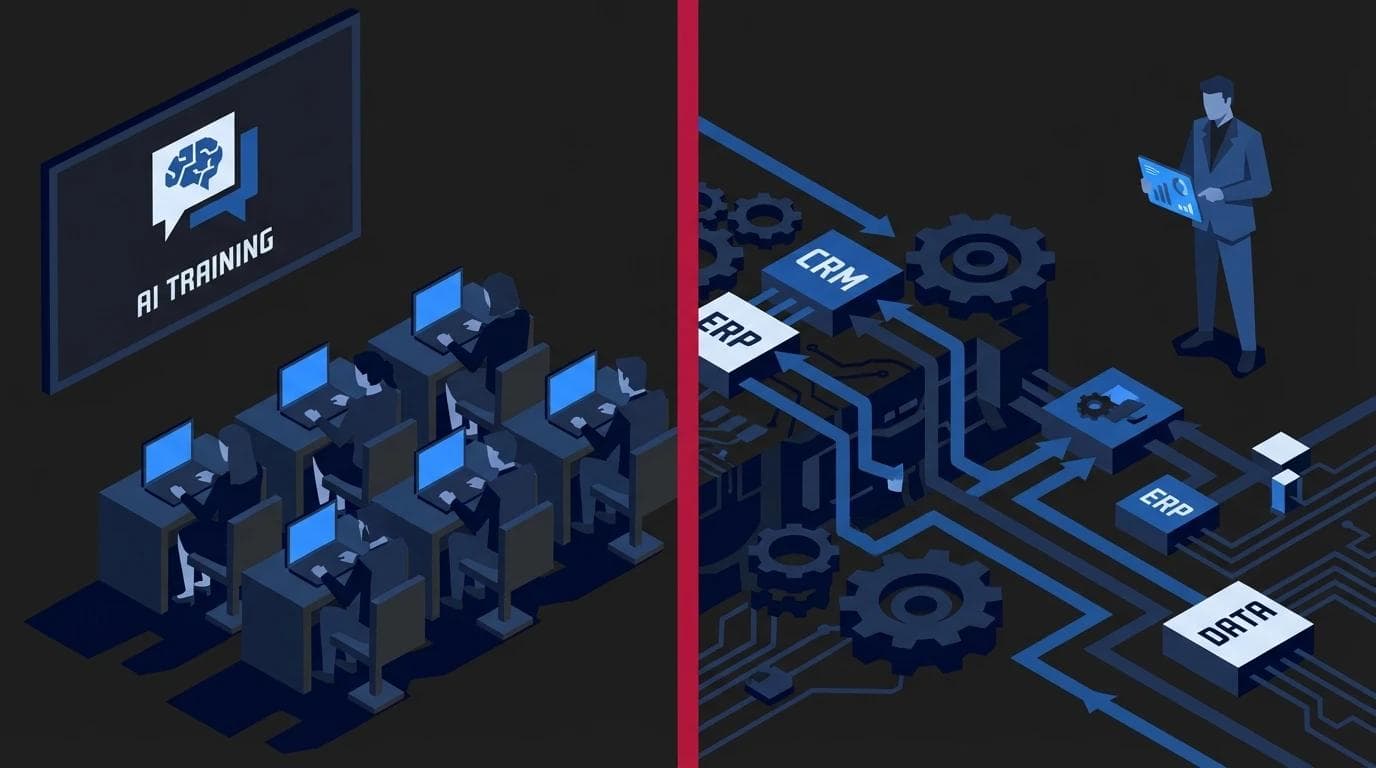
Automation in finance is not just about faster calculations, but primarily about the elimination of so-called human middleware, i.e., manual data transfer between systems. While standard AI finance training often ends with learning how to write prompts, we focus on building systemic data highways. We use the n8n tool for this, which allows for the seamless connection of ERP systems, banking platforms, and language models into a single, unsupervised operational organism.
Clicking through tools on your own is only a half-measure that does not solve the problem of bottlenecks in the controlling department in the long run. Real transformation occurs when comprehensive process automations take over the routine. One of our training scenarios shows this best - every Friday at 3:00 PM, the system automatically downloads a report from the ERP, sends it to a secure AI model to write a synthesis of budget variances, and then generates a professional PDF file that goes straight to the Management Board's inbox. As a result, managers receive ready-made analytics without involving a single minute of the CFO's work.
Intelligent cashflow forecasting using Claude and GPT-4 models
Forecasting financial liquidity gains a new dimension when we add advanced Claude 3.5 Sonnet or GPT-4o models to the equation. Traditional methods rely on rigid formulas, while AI can analyze historical trends and correlations that the human eye simply won't catch in thousands of rows. Our guide to AI training for companies discusses in detail how to teach models "what if" type scenario analysis.
Using language models in forecasting allows for:
- Seasonality detection - AI identifies subtle changes in the payment behavior of contractors that affect the actual time cash enters the register.
- Simulating crisis scenarios - instant building of pessimistic forecasts based on macroeconomic variables provided in real-time.
- Fixed cost optimization - indicating areas where expenses grow non-linearly in relation to achieved revenues.
However, it should be remembered that using public versions of tools without proper knowledge carries the risk of sensitive data leakage. We promote AI security in the company by using Enterprise or API versions that do not use data for model training. In situations where confidentiality requirements are extreme, the best solution becomes dedicated applications with closed infrastructure, where every byte of financial data remains under the exclusive control of the enterprise.
> Step 3 - Ensuring security and privacy of financial data in AI models
Security of financial data in AI is achieved primarily through the conscious choice of Enterprise-class models (with a guarantee of no training on input data) and the implementation of technical anonymization procedures for sensitive information before it is sent to external systems. For Chief Financial Officers (CFOs), this is a key condition for technology implementation - without the certainty that margins, costs, and contractor data are protected, any innovation becomes too great an operational risk.
In 01tech's engineering practice, we place great emphasis on ensuring that AI security in the company does not rely solely on trust in the software provider. Consumer solutions, where data can be used to train models, are so-called Shadow AI, which has no place in the finance department. Therefore, our AI training for business starts with the configuration of secure ChatGPT Team or Enterprise instances and API access, where data confidentiality is guaranteed by a business contract.
Finance is a sensitive point for every organization, which is why we teach analysts specific anonymization techniques. Before any file with margins and costs goes to a secure API for analysis, we show how to "hide" identification data using simple scripts. This process includes:
- Masking contractor identities - automatic replacement of company names and tax IDs with technical identifiers before sending the query.
- Processing raw values - sending only numerical values to the model, which allows for trend analysis and anomaly detection without revealing the business context.
- Local filtering gateways - using process automations, we create scenarios that automatically remove sensitive data from financial documents.
Such a prepared environment ensures that even the most complex digitalization process in the company proceeds without the risk of leaking trade secrets. Instead of worrying about security, the finance team gains tools for instant forecasting and ROI analysis, sending only what is necessary for calculations to the AI models. This engineering approach allows for turning the finance department into a center of modern data analytics.
> Why choose engineering AI training instead of general prompting courses?
Most courses available on the market focus solely on the communication layer, i.e., how to formulate a query so that the language model returns the correct answer. For finance departments, such an approach is insufficient and often leads to disappointment due to the lack of result stability. The engineering approach to the subject, promoted by the comprehensive guide to AI training for companies, assumes that artificial intelligence is not just a conversation interface, but an integral component of a larger IT architecture.
The main difference lies in the transition from theory to full operational efficiency. Instead of teaching employees how to "nicely ask for a table" in a chat window, our AI training for business shows how to physically connect language models with your company software - from ERP systems and invoicing platforms to spreadsheets linked with databases. It is this process knowledge that allows for full independence from tedious, manual work that generates errors and unnecessary costs.
Implementation engineering wins over prompting alone in three key areas:
- Integration instead of copying - general courses teach pasting data into external tools, which creates a real threat, as discussed further in the article analyzing AI security in the company and the risk of data leakage. We teach secure communication via API, where data does not leave your infrastructure.
- Scalability and repeatability - a manually entered prompt only works once. Well-designed process automations work in the background 24/7, automatically categorizing bank statements or verifying the correctness of invoices without human intervention.
- Solutions without a technological ceiling - where the capabilities of off-the-shelf chatbots end, we implement dedicated applications that are tailored to specific financial workflows, such as advanced budget variance analysis or automatic debt collection.
By choosing workshops conducted by engineers who build systems for banking and logistics every day, you can be sure that the implementation will not end with a momentary fascination with a new gadget. We give your team the tools to adapt artificial intelligence to your company's existing infrastructure, instead of adapting financial procedures to AI requirements.
> Frequently asked questions about AI training for finance
AI training for finance focuses on the secure automation of reporting processes, analysis of large datasets, and optimization of controlling. The key goal is to transform the finance department from operational centers into strategic business partners by eliminating routine tasks. With appropriately selected AI training for business, finance teams can work up to 50% faster while maintaining full compliance with data protection regulations.
Is financial data entered into AI secure?
This is the most common concern of CFOs and chief accountants. At 01tech, we teach that security depends on the choice of tools and their configuration. We explain how to use Enterprise-class solutions (e.g., ChatGPT Team or Enterprise), which guarantee that the data entered is not used to train public models.
During the workshops, we show how to disable training at the privacy settings level and when it is worth implementing self-hosted systems. Education in this area is essential to eliminate risky AI security in the company, i.e., the Shadow AI phenomenon, where employees unknowingly send sensitive documents to free, unprotected versions of assistants.
Does AI training for finance require programming knowledge?
The training is designed for people who work in Excel and ERP systems every day, so programming knowledge is not required. We focus on using natural language to communicate with AI. However, as engineers, we go a step further than simple prompting.
We teach how to deal with so-called mathematical hallucinations. LLM language models are not calculators and can make mistakes in simple addition. Therefore, we show how to force the AI to write Python code, which then precisely performs mathematical calculations with a 0% error guarantee. In more advanced scenarios, we implement process automations that integrate these scripts directly with your accounting system.
How quickly does the investment in finance department training pay off?
Return on investment (ROI) is usually visible as early as the first month after implementing AI techniques. Measurable indicators are based on the number of work hours recovered. If a controlling employee saves 10 hours a week just on preparing management reports, the cost of training pays off instantly.
You can read more about how to plan such changes in our article AI training for companies - guide, where we analyze the measurable effects of digital transformation. AI in finance is not only about saving time, but primarily about reducing human errors in formatting and cleaning data, which is invaluable over the entire financial year.