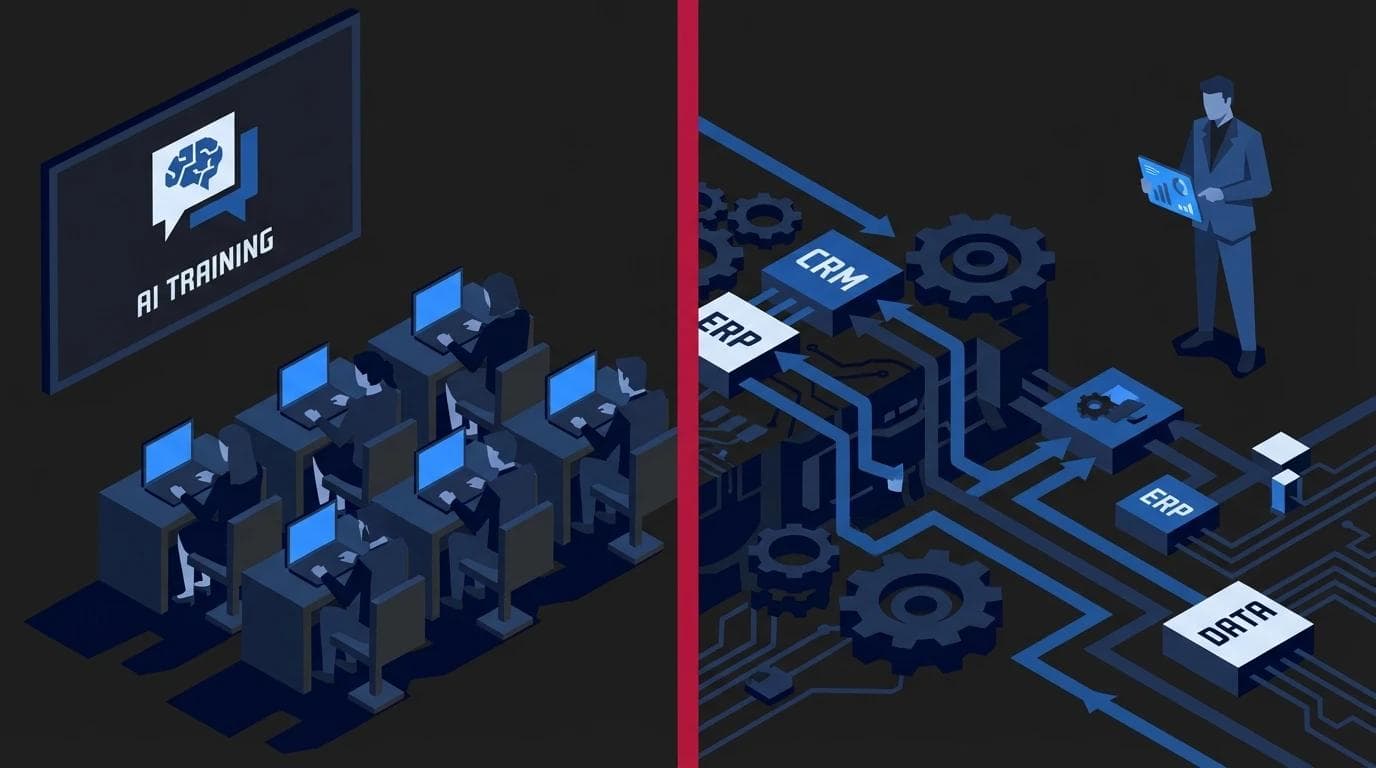
SUBJECT: AI Training for Managers and Boards | Business Strategy

AI Training for Managers and Boards as a Foundation for Modern Business Strategy
> Key Insights for Executive Leadership
AI training for managers is a strategic investment in the security and operational resilience of an organization that goes far beyond learning how to use popular chatbots. The main goal of executive education is to understand that artificial intelligence is not just a tool for writing content, but primarily an engine for process optimization and data analysis. For business leaders, the most important takeaway is the fact that ignoring technology will not stop its adoption by employees - it will only create a gap in intellectual property protection. To truly profit from technology, one must focus on building systems that automate tedious back-office processes, ensuring the company has full control over code and data.
Here are the foundations every manager should understand before starting AI implementation in the company:
- Strategy as a shield against data leaks - a lack of a formalized AI strategy is, in reality, a silent acceptance of the uncontrolled outflow of sensitive information. Employees, wanting to make their work easier, often use private accounts in mobile applications, uploading customer data or company secrets there. Professional AI training for business teaches management how to create secure frameworks and why AI security in the company depends on the awareness of threats coming from so-called Shadow AI.
- ROI hidden in the back-office - the highest return on investment does not come from exposing AI to the customer (e.g., through simple chatbots), but from implementing invisible back-office automations. Streamlining document flow, automatic reporting, or intelligent logistics management are areas where process automations bring measurable savings in time and money, eliminating human errors in the most costly operations.
- Code ownership as financial independence - basing an entire digital transformation solely on subscription tools (SaaS) exposes the company to lifelong commissions and price changes imposed by global giants. Therefore, for key business processes, operational managers should consider dedicated applications that provide full technological ownership and do not have the limitations typical of off-the-shelf solutions. Investing in Custom Dev is about building a lasting asset that grows with the enterprise.
- The manager as a process engineer - modern AI training for operational managers focuses on learning how to design workflows using agents and hardware+software integrations. Understanding how the internet of things (IoT) can provide data to AI models in real time allows for the creation of an intelligent ecosystem that independently reacts to changes in production or the warehouse. Leader education is the first step in a comprehensive guide to AI training for companies, forming the foundation of digital transformation.
> What Professional AI Training for Managers Is and Why Transformation Must Start with Leaders
Professional AI training for managers is a process of building strategic awareness that allows management to distinguish real tools generating profit from temporary fads. The goal of such education is not to learn how to write scripts, but to understand how artificial intelligence changes business architecture and where to allocate capital to obtain the highest return on investment. Transformation must start with leaders because without their direct support, budget, and understanding of technology at the highest level, any digital initiative will die in the maze of bureaucracy at lower stages of the company structure.
At 01tech, we assume that the CEO will not be writing Python code - their role is to build a vision and oversee the implementation of innovation. Our AI training for business consists of strategic meetings where we show the brutal truth about what is currently just loud hype in the IT world and what constitutes a quiet, money-making machine in the background. Managers must know when standard SaaS tools are no longer enough and when it is worth investing in dedicated applications to avoid burning the budget on solutions that do not scale with the company.
Key foundations of professional training for C-level executives:
- Distinguishing technology from business results - the manager learns to evaluate the potential of implementations not through the prism of "modernity", but through measurable indicators such as ai in business roi, analyzing the actual time recovered by the team.
- Security and risk management - a lack of knowledge at the top leads to the phenomenon of Shadow AI. Proper AI security in the company requires the board to introduce clear procedures for using closed models (Enterprise APIs) instead of free, public chats.
- Initiating automation processes - leaders learn to identify bottlenecks that can be solved by advanced process automations. Instead of delegating technology to the IT department, operational managers begin to design the company around digital agents.
Direct involvement of leaders is the only way to break the team's resistance to change. As we emphasize in our comprehensive guide to AI training, technology must be treated as an investment, not an operating cost. Professional training changes the board's perspective: from fear of the unknown to the efficient use of tools that optimize the profitability of the entire enterprise.
> Artificial Intelligence as a Tool for Building a Lasting Competitive Advantage
In today's business, artificial intelligence has ceased to be a technical novelty and has become the foundation of a company's defensive strategy, known as a digital moat. Simply buying a subscription to popular tools does not provide a real advantage, as the competition can do the same at any time. True value appears only when professional ai training for managers teaches leaders how to design unique systems that integrate critical processes with dedicated language models. Thanks to this approach, the organization gains a tangible market advantage that directly increases the valuation of the enterprise itself, making it more resilient to changing economic conditions.
Identifying Bottlenecks and Automation Potential
The practical implementation of technology requires management to change their paradigm from using off-the-shelf tools to deep process thinking. The key to achieving high ai in business roi is a reliable audit of current operations and finding places where human capital is wasted on repetitive tasks. Comprehensive ai training for companies should provide managers with specific auditing methodologies allowing for the effective implementation of AI agents:
- Human Middleware analysis - identifying tasks consisting solely of copying and pasting data between systems. In such areas, process automations based on n8n and Python can shorten execution time from days to just a few minutes.
- Verification of technological barriers - checking if current software has API documentation. If off-the-shelf solutions prove to be too rigid and block growth, managers should consider dedicated applications that provide full code ownership and eliminate the risk of vendor lock-in.
- Data resource audit - artificial intelligence is only as good as the data it works on. A leader must be able to assess whether the company has an organized knowledge base that can feed its own models to create flawless offers or reports.
When a company stops relying on publicly available solutions and focuses on ai training for business aimed at building its own infrastructure, it gains the ability to respond to market needs at a pace unattainable for rivals. For example, an automated system can quote orders 5 times faster and 3 times cheaper than a classic sales team. It is these optimized, integrated processes that create a barrier to entry that the competition cannot overcome simply by purchasing a subscription to ChatGPT.
> Data Security and Ethics in the Board's AI Strategy
Data security is the foundation upon which every responsible strategy for implementing artificial intelligence in an organization rests. It is on the shoulders of the CEO and CIO that the ultimate legal responsibility lies in the face of GDPR or the upcoming AI Act regulations. Management must consciously distinguish public tools from Enterprise-class solutions to protect the company's intellectual property (IP) from uncontrolled leakage into global training sets. Understanding these complexities is a key element offered by professional ai training for managers.
Most organizations currently struggle with the problem of unofficial use of free tools by employees. This phenomenon, known as ai security in the company, generates a massive risk for information security. Without proper education, the team may unknowingly upload confidential financial data or source codes to public servers. Therefore, the board must strive to build closed on-premise or self-hosted environments. This is an absolute basis for investment hygiene, allowing for the preservation of intellectual property security while simultaneously using the potential of LLM models.
When designing ethical and technical frameworks, C-level executives are supported by substantive ai training for companies that emphasize three pillars:
- Privacy by design - understanding why public vs enterprise chatgpt is a decisive choice for maintaining the confidentiality of company data.
- Regulatory compliance - preparing the organization for legal requirements, aided by specialized ai law training focusing on security standards and algorithm auditability.
- Engineering precision - implementing technology in a controlled way, where process automations are based on internal knowledge bases not used by third parties.
The ultimate goal of the board should be to create a culture of innovation based on trust. When using ai in business, we must be sure that data does not become fuel for the competition. Investing in secure infrastructure and reliable knowledge is the only way to scale processes without risking the company's reputation.
> Technology Ownership vs. Subscription Model in Scaling AI Systems
A decision made in the boardroom at the start of a transformation project affects years of operating expenses and the ultimate profitability of the enterprise. The subscription model (SaaS) tends to behave like a taximeter - the more customers your company has and the better profits it generates, the higher the "commission" the provider will collect for AI operations and queries to language models. Building and implementing your own designed ecosystem is a one-time investment that makes your margin independent of market license increases and sudden changes in the terms of service of technology giants.
In the case of intensive scaling, subscription costs can quickly exceed the savings brought by process automations implemented in the team. Technology ownership allows for the building of fixed assets for the company, instead of generating endless OPEX costs that do not build real equity value. This approach makes dedicated applications a safe haven for the organization's know-how, eliminating the risk of vendor lock-in, which is technological dependence on a single provider.
For management, it is crucial that AI training for managers also includes learning cold financial calculation of long-term implementations. Paying "rent" for access to someone else's intelligence can be a good solution at the testing stage, but for mass production, it is worth betting on your own instances of open-source models. This approach allows for a more precise calculation of ai in business roi and ensures the financial stability of projects, which is discussed in detail in our AI training for companies guide.
Correct AI implementation in a company is not just a matter of tools, but of strategic management of resources and copyrights to the code. Transferring intellectual property and the repository to the client is our standard, because only full control over technology provides a competitive advantage. Management, by undergoing professional training on AI tools, learns how to optimize infrastructure so that the system grows with the business without a drastic increase in monthly fees.
> Change Management and Preparing the Team for AI Collaboration
Even the most innovative dedicated applications will not bring the expected ROI to the company if the team sabotages their implementation out of fear of losing jobs. The leader's role in the digitalization process goes far beyond choosing technology - it is the management that is responsible for mitigating resistance and building a culture of trust. At 01tech, we often emphasize that even the best technologists will not help if a mutiny breaks out within the organization. Effective AI training for managers teaches primarily a new communication strategy that turns fear into enthusiasm.
The key to success is changing the narrative regarding automation. A message suggesting job cuts destroys engagement and data quality right from the start. Instead, the manager should explain: we are automating paperwork so that you have time for creative and substantive work with the client. This approach makes the team curious about verifying the results of algorithmic work. Comprehensive AI training from scratch demystifies technology, showing employees that process automations are in reality digital assistants, not their successors.
In our study, the AI training for companies guide, we point to the necessity of involving employees in the change design process. When the team sees that the implemented AI training for business actually solves their daily problems - such as generating repetitive reports or invoicing - resistance disappears naturally. The manager must become an ambassador of change who actively uses new tools and encourages experimentation. Only through AI training from scratch can one build a sense of agency and security in the team, which is the foundation of a modern enterprise.
> Frequently Asked Questions about AI Training for Managers
The decision to start a technological transformation is often associated with concerns about time and competency resources. The following list answers the most common dilemmas of leaders who want to introduce AI training for companies into their development strategy without operational paralysis of the organization.
How much time must a manager devote to effective AI training?
For a busy leader, intensity is key, not the duration of the course. Effective AI training from scratch for management usually concludes in a single day of intensive workshop (4-6 hours). This format allows for an understanding of the foundations without the need to delegate oneself from current tasks for entire weeks. At 01tech, we focus on practice, which means that instead of theory about the history of algorithms, managers immediately work on their own data and real company processes. Further development takes place organically during daily work with the tools, which eliminates unnecessary time costs.
Does a manager need to know how to program to manage AI transformation?
Definitely not. A manager is not there to write code, but to understand its impact on the profit and loss account. At this level, one operates with costs, identification of process "bottlenecks", and broadly understood corporate security. Executing hard code, integrations, and maintaining technical infrastructure is the task of engineers, which can be entrusted to external partners building dedicated applications on clear SLA guarantee terms. Managerial knowledge obtained during AI training for managers is meant to serve for verifying technology potential and effective delegation of technical tasks, not for performing them independently.
What are the measurable success indicators after executive training?
Leader education must translate into hard data. The most commonly monitored indicators are the reduction in time for preparing management reports, an increase in the pace of data-driven decision-making, and real optimization of operating costs. A good example is the implementation of process automations, which allows for recovering from a dozen to several dozen hours of team work per week. To precisely evaluate the effects, it is worth knowing how to measure ROI from AI training, focusing on the value of recovered time and the elimination of human errors in critical business paths. We design our AI training for business so that every manager finishes it with a ready list of processes for immediate optimization.