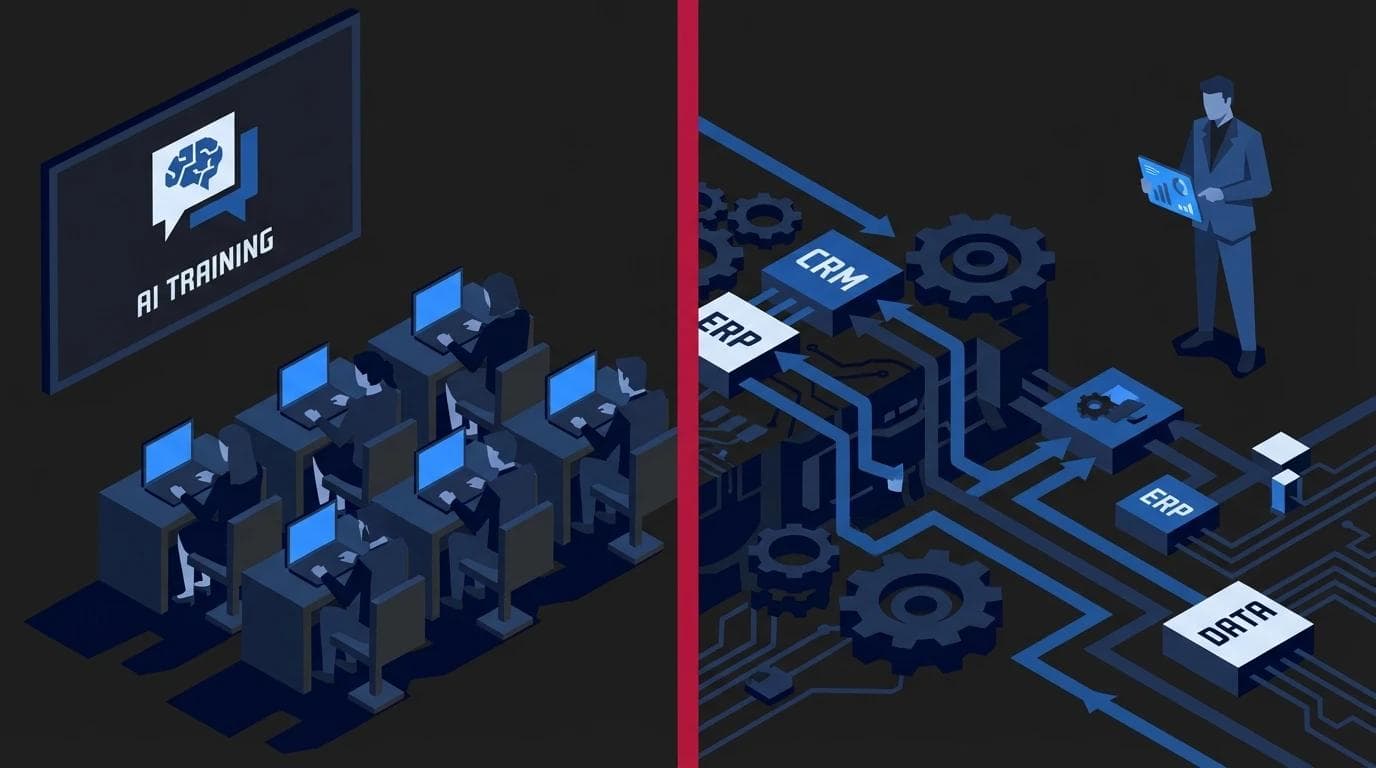
SUBJECT: AI Training for Operational Managers | Autonomous Workflows
AI Training for Operational Managers - Designing Autonomous Workflows and Managing Agents
> Key takeaways
Modern AI training for managers does not teach technology for the sake of technology, but rather shows how to transform a leader into a business systems architect. The primary goal of management education is understanding that AI implementation in a company is first and foremost a process change that eliminates operational waste and increases the measurable efficiency of an AI team. In the era of artificial intelligence, a manager ceases to be just a supervisor and becomes a designer of intelligent workflows who can precisely identify areas requiring optimization. A comprehensive AI training for companies - a guide to this transformation helps avoid errors at the strategic planning stage.
Here are the most important points that every leader planning to implement new technology should internalize:
- Manager as process architect - in the digital transformation era, leaders must understand that their role is evolving toward designing logical structures. Professional AI training for business provides the necessary competencies to manage these changes without requiring a technical background.
- Logic over coding skills - effective implementation of AI agents and the use of process automation is based on efficient algorithmic and procedural thinking. A manager must know how to describe a process so that technology can take it over.
- Elimination of resource waste - the ultimate goal is not "having AI," but the total removal of repetitive, inefficient tasks from the daily schedule. Where off-the-shelf tools fail, dedicated applications that replicate unique company processes 1:1 are most effective.
- Priority on data security - manager education must include conscious risk management. A key challenge is AI security in the company, which means eliminating Shadow AI and introducing secure standards for using closed language models.
- Measurability and profitability of changes - every hour spent on learning must be reflected in financial results. Managers should know how to measure AI training ROI to precisely evaluate real time recovery and operational productivity growth.
> What modern AI training for operational managers teaches
Modern AI training for operational managers focuses on transforming the manager's role from a supervisor of people into an architect of autonomous systems. Instead of simple prompt writing for image generation, participants learn to decompose complex business processes into stages that can be delegated to intelligent agents. The goal is to create a "digital machine" where technology performs repetitive work, and the human team focuses exclusively on managing exceptions and making key decisions. This model allows for scaling operations without a proportional increase in headcount.
At the operational level (COO or Operations Manager), we do not treat artificial intelligence as a curiosity, but as a foundation for efficiency. Therefore, professional AI training for business emphasizes structuring the process of delegating tasks to autonomous scripts. The manager learns how to break down the complex work of their department into small, measurable steps. This is an engineering approach where the human stops being the "bottleneck" of information flow and starts acting as a process quality controller. This is exactly how AI team efficiency is built, where time gain becomes a measurable ROI indicator.
Educational programs for leaders go far beyond the chat interface. Participants learn the differences between public tools and secure ecosystems, which is discussed in detail in our AI training for companies - a guide. Key competencies include:
- Designing agentic systems - building task chains where one AI model prepares data, the second analyzes it, and the third generates the final report.
- Risk management and data security - understanding why free versions of tools can jeopardize intellectual property and when closed models are necessary.
- Mapping processes for automation - identifying areas where process automation will bring the greatest return on investment in the shortest time.
- Matching technology to problem scale - evaluating whether a given problem can be solved by a ready-made bot or if dedicated applications integrated with the company's internal ERP will be required.
Ultimately, the manager learns to think in terms of hybrid resources. Knowledge of how to integrate AI into the daily routine allows for the elimination of the "human middleware" phenomenon - the wasting of employee time on manual data entry between systems. Implementing these principles makes the organization resistant to chaos and ready for the challenges of the modern market.
> From prompting to orchestration - the manager's new role in the AI era
In modern management, the leader's role is evolving from a user of simple tools to an architect of complex operational systems. Instead of typing individual queries into a chat window, managers are becoming orchestrators who design multi-stage workflows for digital agents. The key competency is no longer just efficient command formulation, but the ability to arrange process logic where AI takes over repetitive operations, allowing the team to focus on high-value tasks.
Stop treating artificial intelligence solely as a chat for asking questions. Today's leader is a conductor of digital movement who understands that AI training for business should primarily teach the design of autonomous systems. Just as you arrange a work schedule for people in a warehouse or office, you must be able to set a precise sequence of actions for scripts and agents. Modern process automation allows for building scenarios such as: when a new lead comes in -> research it for potential -> download a report from the database -> send a ready brief to the sales team's Slack.
Moving to a higher level of expertise requires understanding that AI is not magic, but advanced engineering. By using the AI training for companies - a guide, managers learn how to manage a fleet of digital workers who never sleep and never make mistakes when copying data. In situations where standard no-code tools are no longer enough, an engineering approach allows for the implementation of dedicated applications that integrate directly with the company's business core.
The shift from executor to architect has a tangible impact on the organization's financial results. When analyzing how to measure AI training ROI, we notice that the greatest savings are generated not by individual chat responses, but by the systemic elimination of "human middleware" - the manual re-typing of data between systems. A manager who masters the art of orchestration stops being a process bottleneck and becomes a catalyst for the entire enterprise's scalability.
> Designing processes using AI agents step by step
Designing autonomous workflows is the highest level of a manager's digital maturity. Instead of managing only people, you begin managing digital agents who perform repetitive operations 24/7 without the risk of human error. The key to success is moving from simple prompting to full system orchestration, where AI becomes an intelligent link between existing company tools.
Identification of processes with the highest automation potential
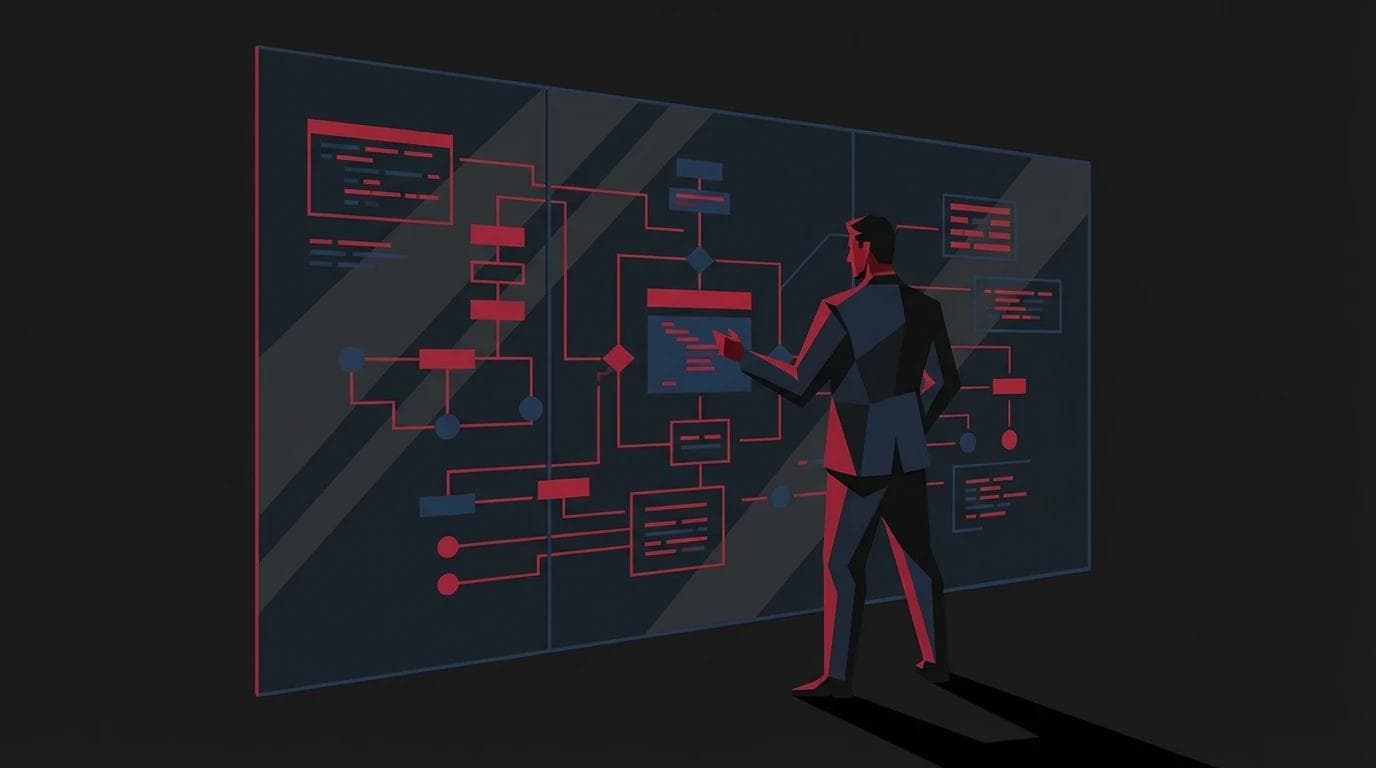
During our workshops, the most difficult moment is always the "blank piece of paper" stage. We then force operational managers to draw the brutal process reality without sugarcoating. For process automation to bring a real return on investment, three steps must be taken:
- Inventory of clicks - list every single mouse click performed by the team as part of a given task. Only such a micro-analysis shows the scale of wasted time.
- Segregation of thinking - mark those actions where the employee does not use critical thinking. If a task involves re-typing data from a PDF to Excel, we don't need a human there, but an algorithm.
- Choosing a narrow segment - do not automate everything at once. Replace a specific, burdensome segment with a hard integration, which guarantees that the script will never go on vacation and will not make a mistake when copying data.
This approach drastically increases AI data security because it eliminates the risk of information leaks through uncontrolled copying of content into public tools.
Technology selection - n8n, Python, and LLM models in the service of operations
A manager does not need to write code, but must be able to select the components from which engineers will build the system. Effective AI training for business emphasizes understanding agentic architecture, which usually consists of three layers:
- Orchestrator (n8n) - a low-code tool that serves as the conductor of the entire process. It connects email, CRM, and databases, directing the flow of information.
- Analytical engine (Python) - where performance and processing of large datasets are needed, scripts come in. Python allows for operations impossible for ready-made plugins, which is the foundation when we build dedicated applications.
- Brain (LLM) - models such as GPT-4 or Claude are used exclusively as text-interpreting links. They do not serve for data storage, but for making decisions based on the provided context.
This engineering approach, which we promote as a key element of AI training for companies, helps avoid a technological ceiling and dependence on a single vendor. Understanding how to connect these building blocks makes AI implementation in a company a predictable business project rather than a technological guessing game.
> Why an operational manager must understand AI systems architecture
Knowledge of AI architecture for a manager is not about programming skills, but the key to managing company risk and security. A manager must understand the path data travels to consciously choose between public tools and secure enterprise-grade environments. Without this awareness, a company risks leaking know-how or becoming dependent on a single vendor. A direct response to organizational needs starts with distinguishing where employee convenience ends and the board's legal responsibility begins.
In today's business ecosystem, AI training for companies often overlooks the foundation: the difference between a publicly available browser application and a closed API operating in a private cloud. As engineers, we emphasize that a manager does not need to write code, but must know where queries sent by their team physically travel. Only then can they effectively block Shadow AI costs in the company, which result from the uncontrolled use of free chats to process confidential documents or client databases.
Understanding basic architecture allows for conscious AI implementation in business based on three pillars:
- Data security and GDPR - by understanding how closed enterprise models work, a manager can distinguish systems that learn from entered information from those that guarantee data isolation. This is crucial when data digitalization and intellectual property security are involved, where protecting unique company processes is a priority.
- Avoiding vendor lock-in - knowledge of the system structure allows for evaluating whether a solution builds a "golden cage" of subscriptions or provides full code ownership. By choosing dedicated applications, the manager ensures the company's technological independence and the ability to migrate systems without losing developed business logic.
- Cost and ROI optimization - instead of investing in expensive, ready-made subscriptions for every employee, you can opt for process automation based on self-hosted n8n. A manager who understands this model sees real indicators of recovered time and can reliably calculate the return on investment, avoiding overpaying for "maintaining air."
In this way, the operational manager becomes the guardian of company know-how. Thanks to the technical knowledge gained during AI training for business, they can independently verify whether proposed tools are secure or pose a threat to operational continuity. This approach promotes engineering standards and allows for building technology on partnership terms, focusing on private environments that protect the enterprise's most valuable resources.
> Measuring the effectiveness of implemented AI agents
Operational managers often make the mistake of evaluating technology success through the prism of production - the number of generated emails or prepared slides. However, modern AI training for managers teaches that artificial intelligence is not a typewriter, but a tool for resource optimization and bottleneck elimination.
The real operational indicator is not the number of generated texts, but the real decrease in operation processing time, known as Lead Time. In the logistics industry, we verify implementation success by analyzing how many minutes the time for generating waybills was shortened after process automation took over routine administrative tasks. Every second shaved off a process that repeats thousands of times a month translates into a specific business profit.
In the B2B services sector, we measure effectiveness through a decrease in Error Rate - the ratio of errors such as incorrectly issued quotes or mistakes in client data. Introducing agents that check data correctness in real-time allows for the elimination of human error, which directly affects the measurable ROI indicators of companies and the brand image in the eyes of contractors.
To reliably report technological successes, a manager must be able to convert the team's recovered time into monetary value. Knowledge of how to measure AI training ROI allows for a partnership conversation with the board about further scaling of systems. In this way, AI training for business becomes the foundation for building a competitive advantage based on hard operational data.
> FAQ - frequently asked questions about AI training for managers
Management often faces a dilemma: how to start implementing technology without being an engineer. Below we have collected answers to the most pressing questions that arise during our technical consultations.
Does an operational manager need to know how to program to design AI processes?
Absolutely not. The modern engineering approach to automation is based on so-called process orchestration, not on writing thousands of lines of code. An operational manager should primarily understand the logic of information flow (workflow) and be able to define data entry and exit points. In practice, process automation is currently built using low-code tools like n8n, where the manager draws the operation scheme, and Python scripts are added by engineers only where standard blocks are not enough. The most important competency is the ability to decompose a business problem into small, measurable steps.
What are the biggest risks when implementing AI agents in a company?
The key challenge is so-called model hallucinations - situations where artificial intelligence generates false information with full conviction. Therefore, when designing systems, we always implement the Human-in-the-loop principle - AI prepares a draft or analysis, but the employee approves the final result. The second critical aspect is data protection. By using public versions of tools, you risk your data being used to train models. Professional ChatGPT training for business teaches how to use APIs and closed instances to maintain full AI security in the company and compliance with GDPR and the AI Act.
How long does it take to train a manager in agentic workflows?
The transition from theory to the first working prototypes is much faster than it might seem. Our practical AI training for business is structured so that after one day of intensive workshops (4-6h), a manager can independently design a simple AI agent. The full guide to AI training for companies suggests that proficiency in managing more complex agentic workflows is achieved after about 2-3 weeks of working on real company processes. Will automation eliminate my team? No. We always repeat: AI implementation frees employees from the role of a machine, allowing them to handle quality supervision and relationships where automation is useless. Investing in competencies is the best way to achieve high AI in business ROI because it is people, not algorithms, who decide on strategic advantage.