SUBJECT: AI Training for Sales - Personalization & Follow-ups

AI training for sales departments - how to personalize offers and automate follow-ups
> What professional AI training for business teaches in the context of sales
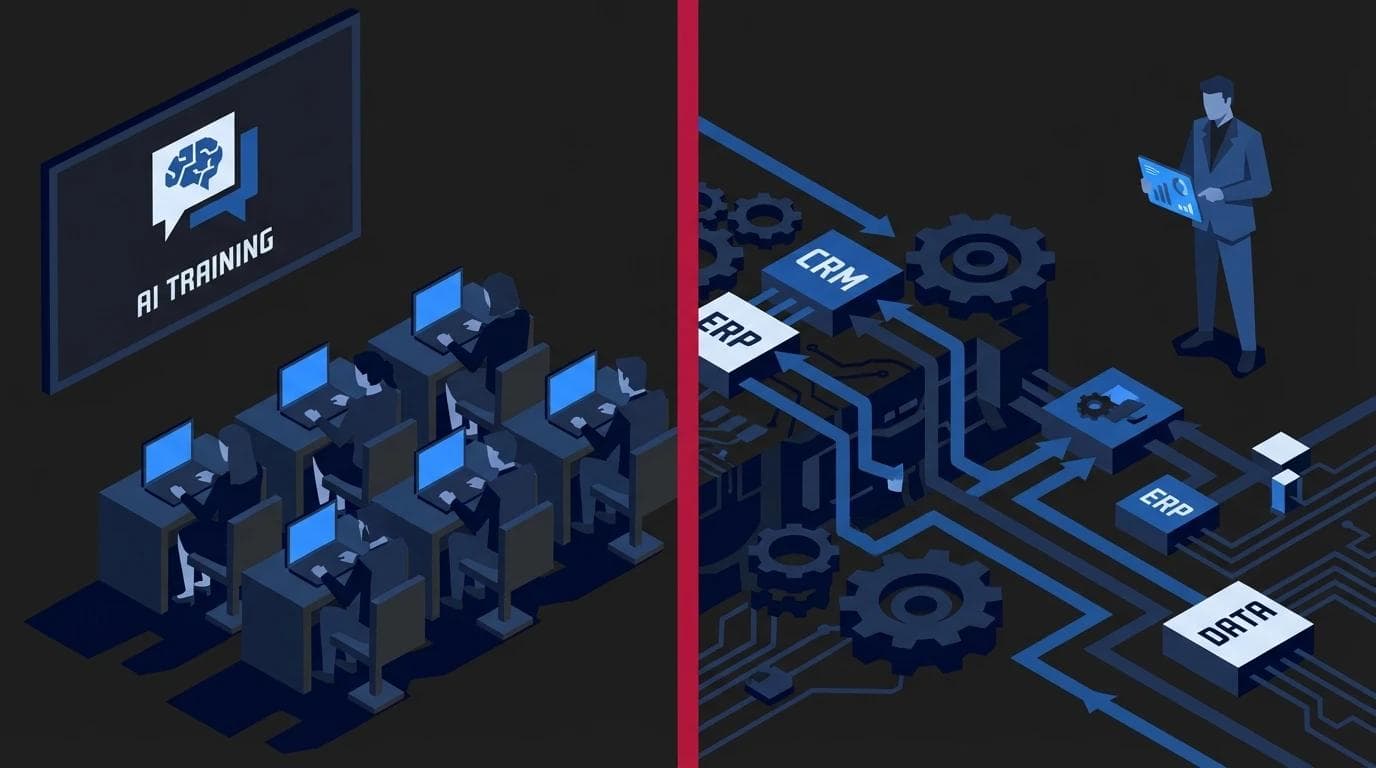
Professional AI training for sales departments marks the end of the era of mass spam and the beginning of precision targeting based on hard data. Instead of teaching how to flood the market with identical offers, we focus on turning the salesperson into a digital detective who uses artificial intelligence to perform advanced analytical work before the first contact. The market is tired of generic automated spam, which is why the key competency today is the ability to construct a single, perfectly targeted message instead of sending a hundred identical offers blindly.
As part of the workshops, we show the practical application of technology: we teach how to harness AI to read a potential customer's website, extract their current market problems, and identify real business needs. This knowledge allows B2B sales reps to stop guessing and start diagnosing. This is the real value of AI training for business - it teaches how to reduce preparation time for a conversation by 80%, while drastically raising the conversion rate thanks to hyper-personalization.
For team leaders, it is also crucial that the entire process takes place in a secure manner. A comprehensive AI training for companies guide often emphasizes that knowing the tools alone is not enough. You need to know how to avoid the risk of a lack of AI data security, meaning the uncontrolled leakage of sensitive sales data to public models. Professional education teaches the use of closed environments and secure APIs, which is the foundation of a modern sales department.
Once the sales team has mastered intelligent personalization, the next step is often advanced process automation. This allows AI-selected leads to be automatically sent directly to the CRM system, along with a ready-made value proposition draft prepared for a specific interlocutor. In this way, technology stops being just a novelty and becomes an engineering tool for scaling profits.
> Step 1 - Using AI for deep needs analysis and customer segmentation
Deep needs analysis is the foundation on which effective AI training for business is based. Instead of relying on the salesperson's subjective feelings, we use language models to objectively process raw sales data. The key here is the elimination of the so-called "Human Middleware", which is the tedious transcription of call notes and manual filling of CRM systems. Properly implemented technology allows transforming information chaos into a precise strategy for reaching selected market segments.
During the workshops, we show teams how to structure contractor data based on real interactions. By uploading a transcript from a 30-minute video meeting into their own secure AI assistant, we teach the model to extract key "business pains" and customer objections that might have been missed during the conversation. The tool automatically prepares a contractor profile, which saves the salesperson an average of one hour of tedious work for every lead. Knowledge of how to safely operate such information is crucial, which is why our AI training for companies - guide places huge emphasis on data privacy.
Sentiment analysis and identification of hidden needs: Practical application of prompts to extract key conclusions from raw sales data
Effective analysis does not end with a simple summary of the meeting content. Modern ChatGPT training for business teaches how to design prompts for advanced sentiment analysis to detect the tone of the statement, voice hesitations recorded in the notes, or the degree of urgency of the problem. Thanks to this, the salesperson knows whether the customer is only at the market research stage or really needs a solution now.
The process of deep segmentation using AI includes:
- Linguistic analysis - recognizing specific phrases that indicate purchase readiness or hidden fears of process changes within the customer's company.
- Objection categorization - automatically assigning customer remarks to groups (budget, technology, trust), which facilitates the preparation of personalized argumentation in offers.
- Connecting market data - enriching the customer profile with external financial and industry data, which is often facilitated by appropriately designed dedicated applications integrated with external databases.
It is at this stage that process automation shows the highest return on investment, because the system can automatically update data in the CRM based on the conclusions extracted by AI. Understanding the difference between free tools and a professional API is critical to avoid the threats we describe when discussing AI security in the company. Ultimately, a well-performed needs analysis allows building value propositions that hit the heart of the customer's problem, instead of being a generic advertising folder.
> Step 2 - Designing tailor-made sales offers with the help of Claude and GPT-4 models
The standard quoting process takes up to several days in companies, which often leads to leads cooling down and loss of sales momentum. In our workshops, we move away from tedious, manual filling of documents in favor of a systemic approach. Salespeople learn to create advanced templates and frameworks based on hard data, which forms the foundation for effective AI training for business.
The mechanism is simple: the AI model takes raw notes from the meeting, analyzes the customer profile in the CRM system, and the company's current price list. In just 15 minutes, the system generates a complete outline of a personalized sales proposal. In this process, the human plays the role of a 'human-in-the-loop' - the salesperson does not waste energy on retyping parameters, but on strategic verification and matching the final arguments.
Such a working method drastically increases ROI, especially when comprehensive process automation is implemented, connecting data exchange systems within the organization. Thanks to this, the company can handle a much larger volume of inquiries without lowering the substantive quality of the prepared proposals.
Prompt engineering for the salesperson - how to avoid the robot effect
The primary concern of managers is that artificial intelligence will generate a soulless text that the customer will recognize in a second. The answer to this challenge is precise prompt engineering, which gives Claude or GPT-4 models a human tone. We teach teams how to inject a unique language of benefits into instructions, tailored directly to the type of decision-maker.
If a salesperson offers advanced dedicated applications, they must use different arguments for an operations director, focusing on efficiency, and different ones for the board, emphasizing the growth of the company's asset value. AI can instantly switch communication styles, provided it receives the appropriate context about the personality and goals of the interlocutor.
It is also worth paying attention to technical aspects - professional ChatGPT training for business explains why it is crucial to use closed API models to protect sensitive data and trade secrets contained in offers. More about the safe implementation of these technologies can be found in our publication, which is the guide to AI training for companies.
Using the 'context injection' technique allows the model to understand the nuances of a given industry. Instead of generic phrases, AI operates on the specific business challenges of the customer, which builds the salesperson's authority from the first page of the sent document. This makes AI training for companies a real competitive advantage, not just a technological curiosity.
> Step 3 - Follow-up automation based on relationship context, not templates
Integrating AI with the CRM system is a real gamechanger in the daily work of the sales department. Most companies make the mistake of sending rigid, generic messages that customers instinctively ignore. During our workshops, which include comprehensive AI training for business, we teach how to set up discrete and effective automation that builds relationships instead of burning them.
When 7 days pass from sending the offer, a specially designed script automatically analyzes the correspondence history saved in the database. Instead of sending a template "have you read the offer?", the AI engine generates a draft reminder email that refers directly to the customer's last question or a specific problem raised during the conversation. Such a follow-up has gigantic effectiveness because it sounds authentic and shows that you are really listening to your interlocutor.
To implement such a process, professional process automation is necessary, connecting data from email, calendar, and CRM into one coherent ecosystem using tools like n8n. Models such as GPT-4o or Claude can instantly catch nuances in the text, which makes the reminder look as if it was written personally by the salesperson after a thorough needs analysis. This is what distinguishes professional ChatGPT training for business from superficial courses - we focus on a real increase in conversion, and not just on technological novelties.
An effective implementation strategy assumes that AI acts as an assistant, not a replacement for a human. The salesperson receives a ready-made content proposal directly in the CRM panel, which they can send with one click after a possible correction. Thanks to this, the team saves hundreds of hours a year, avoiding manual searching of archives and wondering how to approach the customer after a week of silence. If you want to learn more about how technology can support your team in practice, check our AI training for companies - guide, where we describe in detail the path from basic education to full process optimization.
> Why custom AI sales tools are better than ready-made SaaS platforms
The choice between a ready-made system and an engineering solution is the most important decision a CEO planning an effective AI implementation in a company must make. Custom AI sales tools win over SaaS platforms because they eliminate the 'intelligence tax' in the form of high margins imposed by CRM providers for 'Smart' features. By building your own, independent sales workflow (e.g., using n8n on your own server to direct lead traffic), you protect your contact database, maintain full code ownership, and escape the expensive subscription model that drastically stifles the scaling of the sales department with every new employee.
Ready-made AI plugins for popular sales systems are often a technological trap. Although they tempt with a quick start, they lock the company in the so-called golden cages of provider ecosystems. The advantage of custom tools is clearly visible in three areas:
- Finances and scalability - ready-made SaaS platforms charge fees for each user or the number of generated tokens with a high margin. By investing in process automation based on your own infrastructure, you incur a constant, low server cost, regardless of whether your team handles 100 or 10,000 inquiries a day.
- Data security and IP - by using external SaaS tools, you risk that your company know-how will serve to train public models. By implementing dedicated AI training for business, we teach teams how to implement solutions on closed API instances, where data never leaves your company. This is a key aspect when it comes to AI security in the company, protecting trade secrets from uncontrolled leakage.
- Flexibility and ROI - a ready-made system imposes rigid work frames. Meanwhile, the off-the-shelf system vs custom application dilemma is worth resolving in favor of ownership. Proprietary Python scripts can connect data from any source - from legacy ERP to IoT and hardware sensors - creating unique value that the competition cannot buy in a subscription.
Custom tools are not only savings, but above all, the security of the contact database. In the SaaS model, you are only a tenant of a function, and your data is processed according to someone else's rules. As engineers, we believe that the company's key systems should be its assets, not a monthly burden. That is why at 01tech we focus on building dedicated applications, which give full control over the sales process without a technological ceiling.
> FAQ - Frequently asked questions about AI training for business for salespeople
Implementing artificial intelligence in sales departments arouses as much enthusiasm as concern. To move from theoretical considerations to real ROI growth, one must understand that this technology is not a magic "sell" button, but a powerful amplifier of human competencies. Below we answer the most common questions we hear during implementations in the SME sector and startups.
Will AI replace salespeople in the quoting process?
Absolutely not, as long as you do not want your communication to become soulless spam. Artificial intelligence works best as a super-researcher and analyst that searches contact history, technical specifications, or market data in seconds. A concern often arises: will customers not sense the falsehood generated by algorithms? Our expert emphasizes that they will only sense it if you use AI to write texts from scratch, without any verification and personal input. Well-designed AI training for business teaches how to use systems to understand customer intent and prepare the basis for an offer, in which ultimately it is the human who makes the decision about the tone of the statement. AI frees up the salesperson's time from tedious data entry, allowing them to focus on what is most valuable in sales - building an authentic relationship and trust.
What sales data can be safely entered into AI models?
Data security is a foundation that is often forgotten in the pursuit of efficiency. Using free, publicly available versions of tools for customer base analysis is a straight path to trade secret leakage and GDPR problems. To avoid the risk generated by AI security in the company, sales teams should work exclusively on Enterprise models or through secured APIs. It should be remembered that ChatGPT training for business emphasizes working in closed ecosystems, where data is not used to train public algorithms. Entering detailed contract terms, first and last names, or unique pricing strategies is permissible only when you use technology that guarantees full retention and privacy at the corporate level.
How much time is needed for the sales team to start realistically using AI?
The first effects are visible almost immediately, provided that learning is based on working with the living organism of your company. An intensive, one-day workshop, which our AI training for companies - guide describes, is enough for salespeople to stop being afraid of technology and start building simple assistants for research. However, a full implementation, in which systems automatically qualify leads or generate report drafts, usually takes from two to four weeks. In this process, process automation is key, connecting AI tools with your current CRM. From our experience, the sales team starts to feel full freedom in using artificial intelligence after completing 3-4 real quoting processes supported by algorithms, which allows them to recover from 10 to even 15 working hours per week.