SUBJECT: How to Calculate AI Training ROI - Formula & Business Impact

How to measure AI business ROI after team training - methodology and real time savings
> Effective formula for calculating return on investment in AI training
Calculating the return on investment (ROI) in artificial intelligence is based on a simple, mathematical difference in a company's operating costs before and after implementing the new technology. The most effective formula is: ROI = (Labor cost before implementation - Labor cost after implementation) - (Training cost + Monthly tool licenses). If your team reduces the time spent on repetitive tasks by half after completing a course, every hour saved becomes a real profit that quickly covers the expenditure on AI training for business. In practice, measurable effects appear where algorithms replace routine, freeing employees for tasks that require human creativity.
At 01tech, our mathematics is absolute because we treat technology as an investment that must pay for itself. Instead of focusing on abstract "potential" or the "future of the world," we analyze real time savings in specific processes. For example, if an employee costing the company 80 PLN/h manually sorted and described documents for 20 hours a month, they generated a cost of 1600 PLN. When, after proper preparation, they implement a script we designed that costs only 50 PLN per month to run, the investment pays off immediately. This engineering approach allows for a precise assessment of how reliable AI training for companies translates into a hard financial result.
To get a full picture of profitability, three key variables must be considered:
- Time audit before the change - precise measurement of how many minutes per day the team spends on tasks that can be automated, such as writing proposals, categorizing emails, or analyzing spreadsheets.
- Entry and maintenance costs - the one-time expense for practical workshops and the time employees spent learning instead of on operational work, plus the cost of licenses (e.g., ChatGPT Plus).
- Process repeatability scale - the more often a given activity is performed, the higher the ROI. This is perfectly visible when we implement AI training for sales, where automation of follow-ups and research frees up salespeople to build direct relationships with key clients.
Only after comparing this data does it become clear that implementing AI in a company is not a costly gadget, but pure resource optimization. Every organization that wants to avoid burning its IT budget should start with a hard calculation. If an automated process saves 15 hours a week across the team, you reclaim more than half a full-time position without hiring a new person. This is the real return on investment that allows companies to grow without linearly increasing employment costs.
> Case study - how an administration department reclaimed 15 hours per week through intelligent scripts
For one of our service sector clients, the problem was classic "human middleware." Three office employees spent the lion's share of their time every day on the tedious task of retyping data from hundreds of incoming PDF invoices into the accounting system. This manual work not only lowered morale but also generated risky typos, especially when entering tax IDs, which often resulted in the need to issue correction notes.
To permanently solve this problem, we conducted dedicated AI training for office administration, during which the team learned how to safely process documents using language models. A key element of the workshop was AI data security - we showed employees how to disable model training on company files and use Enterprise-grade solutions to maintain full confidentiality of financial information.
The next step was implementing an automated API workflow that eliminated the manual copying stage. Such process automation acts like a digital employee: the system independently parses data from documents, verifies its correctness, and sends it directly to accounting. This approach ensures that AI training for business stops being a theory about the future and becomes a real tool for building operational advantage.
The measured effect of this implementation was clear: the team reclaimed 15 hours per week, while eliminating data entry errors to zero. The freed-up human resources could be redirected to more demanding tasks, showing that a well-planned AI implementation in a company pays off within the first few months of launch. Where Excel and paper document workflows are no longer sufficient, the best solutions are dedicated applications that integrate the physical world with intelligent software.
> Measuring efficiency in sales - reducing quoting time by 70 percent
Time is profit. In a dynamic B2B environment, the speed of preparing a proposal is often a more important decision factor than the price itself. Real implementation of artificial intelligence in a sales team allows for shortening the process of preparing a technical quote from several days to just a few hours. The most effective metric for the profitability of such an investment is the Lead-to-Quote time, which directly affects the conversion rate and competitive advantage.
In engineering-profile companies, the technical project quoting process usually took an average of 3 business days. This delay resulted from the need to involve developers in the initial analysis of documentation, which distracted them from working on code. By organizing an internal knowledge base and conducting AI training for business, the sales department gained access to precise technical assistants. Using models such as Claude 3.5 Sonnet or GPT-4o to analyze complex specifications allowed salespeople to independently generate substantively correct offers in just 4 hours.
Key benefits from the sales department transformation:
- Drastic reduction in quoting time - a reduction from 72 hours to 4 hours is a time saving of over 90 percent.
- Greater communication personalization - AI models analyze the client's style and adapt the language of benefits to the specific needs of decision-makers.
- Unlocking engineering power - technical specialists no longer need to participate in every stage of quoting, allowing them to focus on creating dedicated applications and real products.
- Increase in conversion rate - a fast and substantive offer sent the same day drastically increases the chances of closing the sale.
Our AI training for B2B sales emphasizes practice and data security, eliminating so-called Shadow AI in favor of controlled processes. It is worth remembering that digital transformation is a continuous process - a comprehensive guide to AI training emphasizes that team education is the foundation on which later automation and individual technological solutions are built.
> How to include opportunity costs and work quality in AI business ROI
ROI in technology projects is often associated exclusively with a spreadsheet where the sum of savings must exceed the cost of implementation. However, this is a cognitive error that ignores the foundation of a modern company's efficiency - opportunity costs and the quality of the work environment. CEOs often forget about invisible costs, such as frustration and staff turnover resulting from performing tedious, repetitive tasks.
If your qualified specialist spends 30% of their day manually retyping data between systems, they effectively become a human photocopier, which is the shortest path to professional burnout and resignation. This is why reliable AI training for companies should focus on how to remove this burden from the team's shoulders. Reclaimed time is not only a financial saving but, above all, the possibility of shifting resources to high-value strategic tasks that directly generate cash.
When analyzing ROI from a work quality perspective, the following aspects should be considered:
- Increase in specialist retention - eliminating routine through new technological competencies makes employees less likely to look for new challenges with the competition, which drastically lowers recruitment costs.
- Reduction of human errors - where a human makes mistakes due to fatigue, process automation maintains full precision, eliminating the need for costly corrections.
- Ability to scale without hiring - by implementing artificial intelligence, a company can handle a larger volume of orders with the same staff, which changes the fixed cost structure.
It is worth noting that comprehensive AI training in business builds a culture of innovation where technology supports humans rather than limiting them. By investing in dedicated AI training for business, you close the competency gap and turn skeptics into power-users. It is these soft indicators, and not just direct cost cutting, that determine long-term competitive advantage in the era of digital transformation.
> Engineering approach to implementation - why a course alone is not enough for real profit
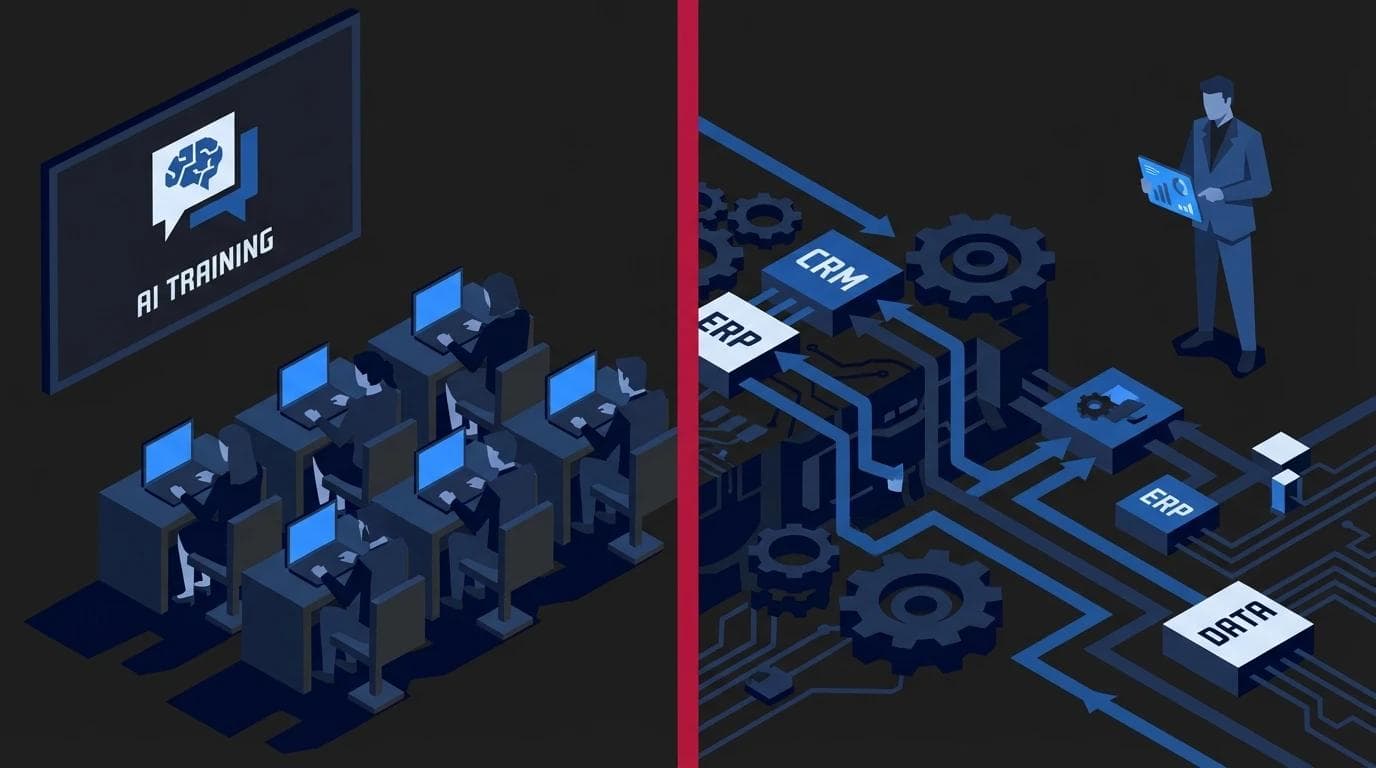
Maximum ROI from AI in business is achieved exclusively by moving from theoretical education to the practical implementation of tools integrated with the company's IT architecture. Self-study courses often generate costs without measurable profits, while 01tech's engineering approach focuses on automating tasks directly within CRM or ERP systems using real enterprise data. Only then does technology stop being a curiosity and become an asset that actually shortens document circulation time and lowers operating costs.
Sending a team to a theoretical training that ends with a certificate posted on LinkedIn rarely translates into faster invoicing or better customer service. In reality, free online courses or general lectures often deepen chaos by introducing tools into the company that cannot talk to each other. This is why our guide to AI training for companies emphasizes that every hour of learning should end with a specific process improvement. Real AI training for business must go beyond simple prompting and touch the operational logic of your company.
Full ROI is obtained only when a solid workshop is followed by implementation - that is, an engineering connection of AI tools directly with the database, sales system, or warehouse. In such a model, the employee does not need to remember to launch an external application. The process runs itself because process automation based on n8n and Python works in the background, eliminating so-called human middleware - the need to manually retype information between browser windows.
Our philosophy assumes that technology should serve the business, not the other way around. Instead of salespeople, a technical expert participates in every project discussion, which we describe in more detail in the about us section. This approach allows for constructing Enterprise-class systems even for the SME sector. Instead of learning about the future of the world, your people learn how to close a specific task in five seconds instead of an hour.
Here are the key differences that determine whether your investment will pay off:
- Company data vs test data - training on random examples from the web does not solve your problems. An engineering workshop takes place on your files and real customer inquiries.
- Integration vs isolation - using ChatGPT on its own is isolation. Connecting an AI model with your CRM's API is automation that generates profit.
- Code ownership vs subscriptions - by building dedicated applications with AI modules, you become the owner of the technology, which radically changes the cost structure in the long term.
Engineering implementation is also a guarantee of security. We teach the team how to disable model training on your sensitive data and how to use closed API environments to maintain compliance with GDPR and trade secrets. Without this foundation, even the most efficient tool can become a source of reputational and legal losses.
> FAQ - most common questions about the financial dimension of AI training
Below we have gathered key answers to the questions most frequently asked by business owners and managers planning to implement artificial intelligence. Our answers are based on real implementation data and engineering efficiency analysis.
How soon does the investment in team training pay off?
From our experience, savings in reclaimed man-hours are visible basically from the first full month of operation of automated processes. With well-chosen priorities, the break-even point usually occurs within 2-4 months after the end of the workshops. The key is to hit the company's biggest bottleneck - if we identify the process that wastes the most time, the project pays off in the first quarter. Professional AI training for business is therefore not a cost, but a short-term investment in operational liquidity.
Does AI business ROI include the costs of paid tool licenses?
Yes, a reliable ROI equation must take into account operating costs such as ChatGPT Team, Claude subscriptions, or API access. Despite the need to incur monthly fees, the balance remains decisively positive because the cost of one license is usually a fraction of the value of an hour of work of a qualified specialist. However, it is important to understand the differences between public ChatGPT vs Enterprise API so as not to overpay for functions the company will not use, or risk data leakage in free versions. Proper tool configuration is an integral part of what we describe as comprehensive AI training for companies, where we teach optimization of not only time but also the tool budget.
How to measure the increase in work quality that is not visible in Excel?
Although the numbers are absolute, many benefits of AI implementation are qualitative in nature, which translates into money indirectly. It is worth measuring indicators such as:
- Decrease in the number of errors - intelligent scripts and AI validation significantly reduce mistakes in reports or invoices, which is crucial when we conduct AI training for finance and accounting.
- Shortening onboarding time - thanks to internal AI knowledge bases, new employees become independent faster, which lowers the cost of their implementation.
- Greater throughput without hiring - the company can handle more inquiries or projects with the same headcount, which drastically improves margins.
Often it is these "invisible" improvements that make process automation the foundation for scaling a business without a linear increase in fixed costs.