SUBJECT: Secure Data Digitalization and Know-how Protection
Data Digitalization and Intellectual Property Security in Business
> Key takeaways
Data digitalization in a modern enterprise is the process of transforming scattered information into a structured digital asset that forms the foundation of competitive advantage. Effective digitalization requires not only the right tools but, above all, a strategic approach to technology ownership and information security. A key element is understanding that data about customers, invoices, and daily operations is the company's most valuable asset, which must not be mindlessly handed over to public clouds, as this risks losing control over critical processes.
The most important points regarding secure and profitable digitalization:
- Know-how protection through ownership - investing in custom applications that you own allows you to avoid the traps of the SaaS model and guarantees that your company's unique processes are not taken over by external providers.
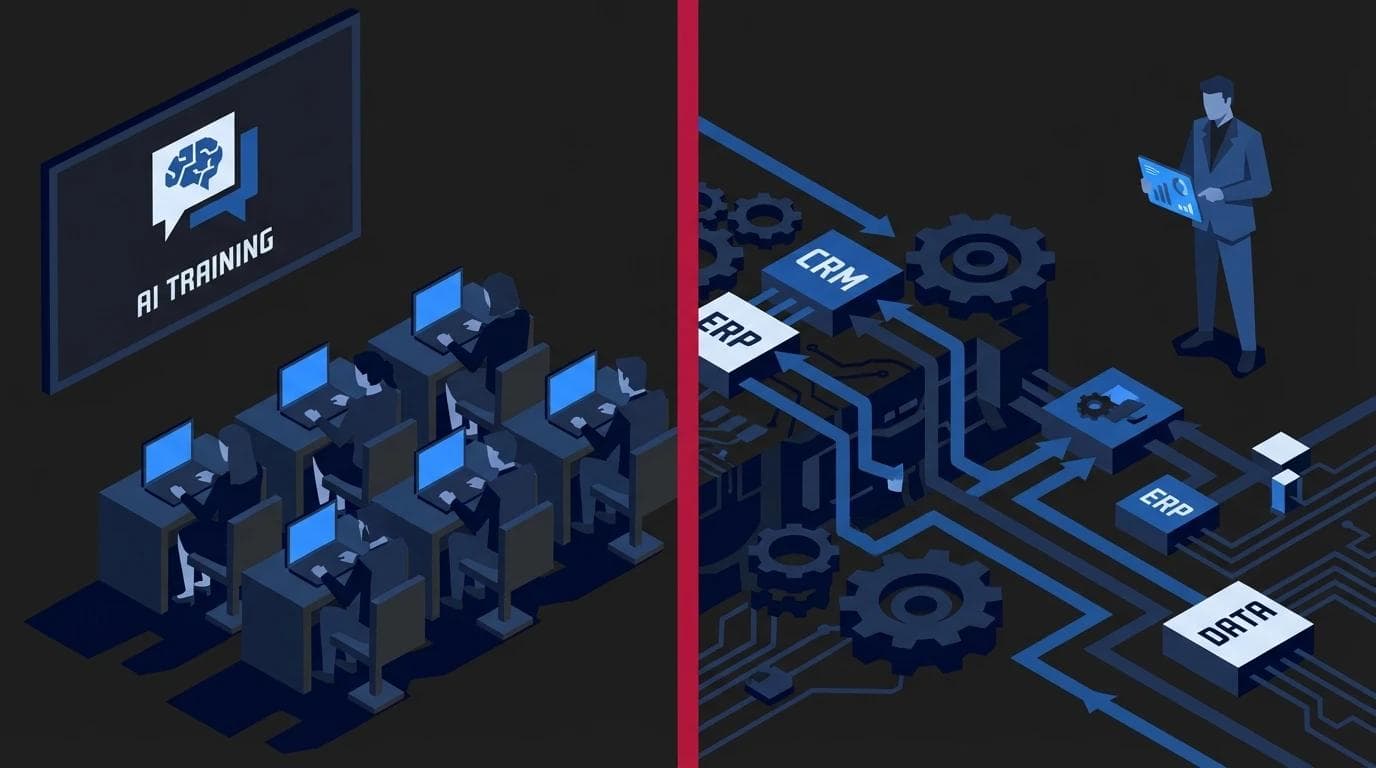
- Data security in the AI era - uploading sensitive information to free artificial intelligence tools violates GDPR regulations and threatens trade secrets, which is why professional AI training for business is essential to teach safe work with new technologies.
- Consistency and order in information - a properly designed digitalization process eliminates information silos and ensures that every unit in the company works on a single, true version of the data.
- Strategic investment planning - every digitalization strategy should involve building your own IT ecosystem, which is more profitable in the long run than paying for dozens of subscriptions.
- Automation as the ultimate goal - digital data should serve as fuel for process automation, which frees up employees' time from repetitive, bureaucratic tasks.
Remember that digitalization without a solid plan can lead to chaos and unnecessary costs. Therefore, the foundation should always be a reliable analysis of needs and the choice of technologies that remain under your full control, building real capital value for your enterprise.
> Secure data digitalization - why system ownership is key to know-how protection
Secure data digitalization is based on a simple paradigm: whoever owns the code and infrastructure possesses real control over the information. In an era of widespread IT outsourcing, technological sovereignty is crucial for protecting know-how, ensuring that data does not physically leave the company's private resources. By choosing systems they own, entrepreneurs eliminate risks associated with dependence on external providers and minimize the exposure of sensitive processes to attacks targeting mass cloud platforms.
When you opt for a ready-made SaaS subscription, such as a cloud CRM, you are unknowingly handing over your most valuable customer database and operational knowledge to an external entity. At 01tech, we believe that a secure digitalization strategy must be based on digital sovereignty. Instead of shared platforms, we build dedicated (self-hosted) environments for our clients. You gain control: data does not leave your private servers, and you decide who has access to it.
System ownership protects your competitive advantage on several key levels:
- Physical information isolation - your resources are not stored in the same bucket as thousands of other companies, which drastically reduces the risk of leaks during mass security incidents at global providers.
- Full access control - you decide who and on what terms can view the ongoing digitalization process, without the involvement of third parties from corporate technical support.
- Protection of unique business logic - dedicated process automation is designed around your unique know-how, and its operational logic does not become part of a subscription platform's publicly available algorithm.
Ignoring the aspect of ownership is a direct path to what we define as the negative consequences of digitalization, where a company becomes a hostage to technology it does not control. Properly designed custom applications become a permanent asset of the company, rather than an operating cost that might disappear with a change in the provider's terms of service.
Secure digitalization is about consciously building a wall around your own intellectual property. Thanks to tailor-made solutions, data becomes a secure foundation for further development, allowing, for example, for safe AI training for business that utilizes only your internal data sets.
> Risks associated with storing data in public SaaS clouds
Storing data in public SaaS clouds involves the risk of losing control over confidential information, a lack of influence over provider terms, and exposure to hacker attacks targeting external infrastructure. The greatest threat is the possibility of the provider using company data to train their own artificial intelligence models without the explicit consent of the data owner. By choosing a subscription model, a company places its most valuable assets in foreign hands, which, in the case of consequences of digitalization without proper legal protection, can lead to irreversible loss of know-how.
The biggest danger is that you do not control the terms of service. SaaS providers regularly update their terms, often introducing clauses that allow them to use aggregate data for market analysis. Even worse, in the era of the machine learning boom, your data may be used to train public AI models without your knowledge. To understand how to use these tools safely and protect your intellectual property, it is worth considering professional AI training for business, which teaches where convenience ends and privacy violation begins.
Key operational risks in the SaaS model include:
- Regulatory instability - a provider can change the rules of the game overnight, and you have no influence over it, which can affect how document digitalization is carried out in your enterprise.
- Risk of downtime and hacker attacks - if a giant's infrastructure falls victim to an attack, your company also loses access to operations. In such a situation, you are left reading their apologies on social media while your processes stand still.
- Shared environments (Multi-tenancy) - your company's data is physically located on the same servers as the data of thousands of other entities, increasing the risk of lateral leaks.
Understanding these threats means that a proper digitalization financing strategy should involve building your own technological resources instead of relying entirely on external rentals. The safest alternative that eliminates these threats is custom applications, providing full control over the source code and database location. Technological ownership is the only way to avoid a situation where an external provider becomes a silent co-owner of your success.
> How to design a data digitalization process that protects intellectual property
Designing a secure digitalization process requires moving from a public cloud model to an architecture based on technological sovereignty. The key to protecting intellectual property is building sealed environments where data never leaves the controlled infrastructure in an unencrypted form. A properly implemented digitalization strategy eliminates the risk of know-how leaks through rigorous encryption and isolation of processing tasks from public SaaS services.
In engineering practice, we secure processes at the architecture stage. For mass processing of thousands of invoices or contracts, we use dedicated installations (e.g., on a local server) instead of opening the company to the outside. Communication with the infrastructure occurs only through strictly encrypted API keys, making your files just a stream of characters resistant to leaks. Such a digitalization process guarantees that even if data interception is attempted, it remains completely useless to unauthorized persons.
Choosing between a custom system and a ready-made solution
The choice of software is the moment when the level of control over company know-how is decided. Off-the-shelf solutions (SaaS) are quick to implement but lock the company into an architecture over which it has no power. In the event of a failure or leak at the provider, your data is exposed just like thousands of other companies using the same mass service. A lack of control over the source code also prevents full security auditability.
On the other hand, custom applications allow for the construction of a tailor-made system where every element of the infrastructure is designed with your unique security needs in mind. These solutions have no technological ceiling and provide full code ownership, which is crucial when the consequences of digitalization without a plan can cost the loss of competitive advantage. By investing in a dedicated system, you build real technological assets for the company instead of merely leasing access to someone else's tools.
Process automation as a way to eliminate human error
The weakest link in intellectual property protection is usually the human factor. Manual document digitalization involves the risk of accidentally sharing confidential information or losing it due to operational error. Introducing intelligent mechanisms allows for a drastic reduction in unauthorized access to sensitive company data, replacing manual tasks with precise scripts.
By implementing modern process automation, we create secure data pipelines where files are processed by machines without employee contact. Such a system automatically categorizes data, encrypts it, and sends it to the appropriate databases, bringing measurable benefits of digitalization in the form of increased ROI and security. If you are planning to digitalize key assets, it is worth making direct contact with experts to design an architecture resistant to modern cyber threats.
> Investing in proprietary technology as a foundation for security strategy
Building a lasting market advantage through digitalization requires SME leaders to shift their perspective from being a passive subscriber to becoming an owner of digital assets. By treating software as a CapEx-type investment, an entrepreneur creates a foundation upon which every effective digitalization strategy resistant to market turmoil is based. With your own code, you possess a digital fortress that protects key know-how from uncontrolled leaks or sudden loss of access to operational systems.
In a subscription model, the security and continuity of your business depend on the financial health and policies of an external provider. By investing in custom applications that you own, you eliminate the risk that someone will cut off your access to the customer database due to an unpaid subscription invoice or an unexpected service shutdown by a foreign provider. This approach is crucial when analyzing the benefits of digitalization, where operational stability directly translates into the real market value of the company.
The foundation of a secure technology strategy rests on three pillars:
- Full control over databases - code ownership allows for custom encryption and choice of server locations, which is critical in the process of protecting sensitive data and intellectual property.
- Independence from the provider product lifecycle - you avoid situations where a function critical to your company is removed from a SaaS platform during an update without your consent.
- No technological ceiling - as the company grows, the created process automation can be scaled and modified without the need to pay additional license fees for every new user.
A properly designed digitalization process considers technological ownership a priority from day one of project work. It is worth remembering that the consequences of digitalization carried out in haste and without an ownership plan are usually a costly technological debt and dangerous vendor lock-in. Instead, a reliable digitalization financing and code ownership strategy builds real company assets. For systems collecting data from production floors or the field, it is worth implementing your own IoT and hardware solutions so that the physical layer of information flow also remains under the exclusive control of the enterprise.
> Frequently asked questions about secure data digitalization
Secure data digitalization is based on full control over infrastructure and avoiding public tools for processing sensitive information. Although cloud solutions seem convenient, building your own technological assets guarantees the highest level of intellectual property protection and full predictability of operational costs in the long term.
Is data digitalization on your own infrastructure more expensive than SaaS?
Many entrepreneurs fear that building their own system generates massive maintenance expenses, but in reality, a digitalization strategy based on code ownership eliminates the constant licensing tribute paid for every user. Owning your own system does not mean problems with security updates - maintaining a dedicated server and implementing patches is a standard, very predictably priced service. In the long run, your own custom applications prove to be much cheaper than multi-year SaaS subscriptions, which drastically increase the consequences of digitalization without a solid financial plan.
What are the biggest threats to intellectual property in the digitalization process?
The greatest risk is the uncontrolled leak of data through free external tools, because if your employees paste confidential documents into public AI chats, your intellectual property is no longer protected. To maintain security, it is worth implementing closed API integrations that allow for stable process automation, for example, for automatic invoice reading within your own network. A properly designed digitalization process must include the elimination of dependence on external providers who can change data access terms or protection levels at any time.
How can I check if my current digitalization system is secure?
Effective document digitalization requires regular verification of IT standards and team awareness. It is worth conducting a quick security audit, paying attention to the following aspects:
- Access control - whether every employee has access only to the data necessary for their tasks.
- Information encryption - whether data at rest and in transit is secured against reading by unauthorized persons.
- Team education - whether the company conducts AI training for business to make staff aware of the risks of using publicly available language models.
- Hardware independence - whether your IoT and hardware solutions send signals to manufacturer clouds or directly to your own databases.
Regular monitoring of these areas allows you to maximize the benefits of digitalization without exposing the organization to losses. If you have doubts about the tightness of your current systems, we encourage you to make contact for a professional infrastructure analysis.