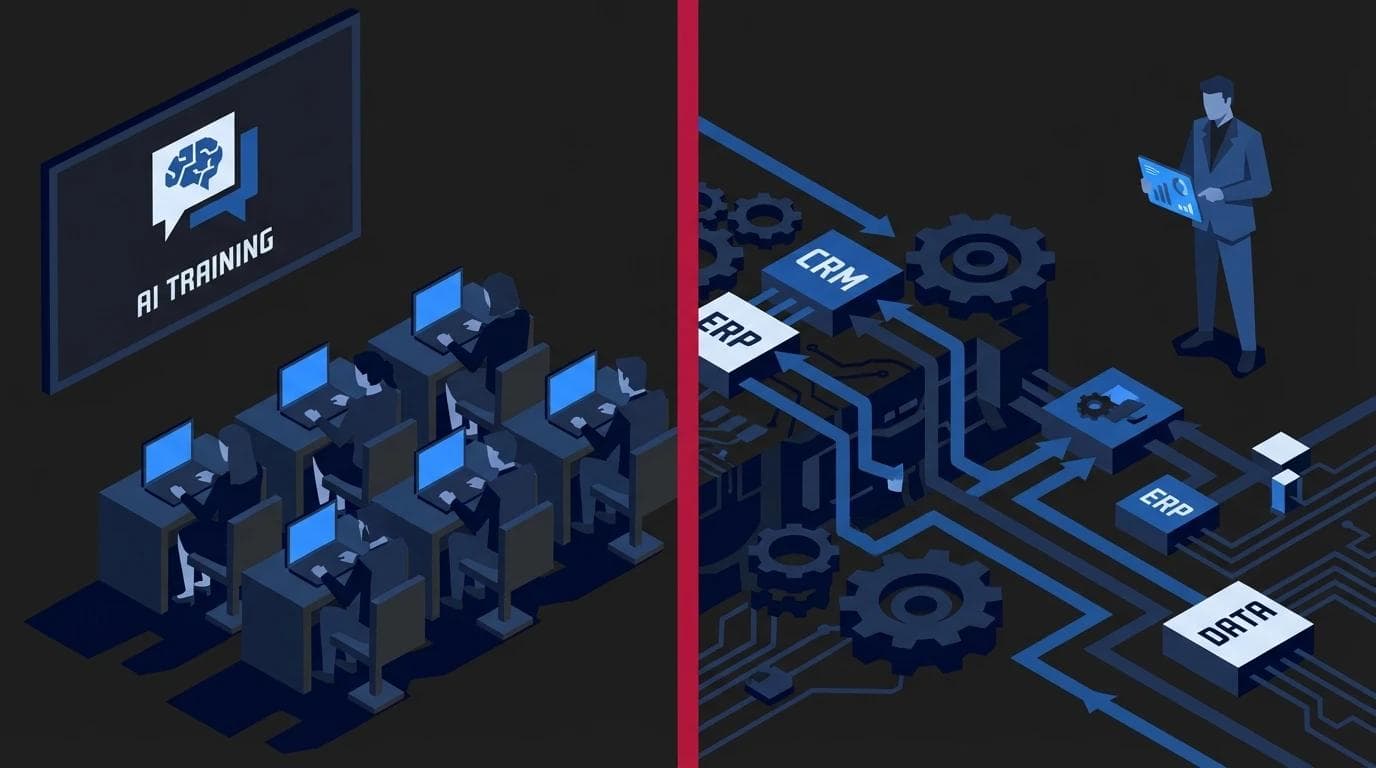
SUBJECT: Measuring AI Training ROI and Effectiveness for Business
Measuring AI training effectiveness and business ROI - a guide to profit calculation methodology
> How to calculate AI business ROI after a training cycle
Calculating the return on investment (ROI) in artificial intelligence after an educational cycle is based on comparing hard financial data, not on subjective employee satisfaction. To determine the real ai in business roi, you must compare the total cost of implementation (training, licenses, environment configuration) with the value of recovered man-hours and the reduction of operational errors. In engineering practice, this means that every minute saved by an employee thanks to AI is a direct operational profit for the company.
Stop measuring the success of courses by the level of enthusiasm over free office coffee. Real ROI is a hard Excel sheet showing that a CapEx investment in your own environment and AI training for business pays off the moment the team stops wasting time on manual system searches or hand-keying data. The basis of the calculation is understanding that training only shows the technology, while engineering effort is what makes the solution truly "click" within processes.
To reliably evaluate effectiveness, focus on the following indicators:
- Value of recovered man-hours - multiply the number of hours saved on routine tasks by the employee's hourly rate, including taxes and employer costs. This is the most measurable component of operational profit.
- Reduction of Shadow AI costs - eliminating uncontrolled use of paid or free tools by employees in favor of a single, secure corporate standard significantly reduces data leak risks and unnecessary licensing expenses.
- Scaling without headcount growth - check how many more processes (e.g., leads handled or reports generated) the same team can perform after implementing process automation based on language models.
- Break-even point - the moment when cumulative savings equal the initial outlay for AI training for companies. With each subsequent month, this mechanism simply records pure profit for the company.
Understanding this mathematics is key to ensuring that digital transformation is not just a trendy slogan, but a stable foundation for growth. If the investment in knowledge is supported by the implementation of specific tools, the company gains resilience to rising labor costs, transforming boring routine into high engineering productivity.
> Methodology for calculating saved man-hours and dollars
Precisely calculating AI ROI in business comes down to hard operational mathematics. To find the real profit, you must compare the total implementation cost - including professional AI training for business and tool configuration - with the value of recovered time multiplied by the specialist's hourly rate. However, true savings appear where the employee stops being a "human link" between systems and starts acting as an auditor of technology-assisted processes.
Step 1 - pre-implementation audit and process mapping
We start every effective transformation project by establishing a baseline. In our daily engineering work, we often begin workshops with a stopwatch measurement. We select the most tedious, repetitive task - for example, "transcribe 30 orders from a PDF file into ERP system rows." Data from such a measurement is ruthless: it turns out that a person in accounting takes an average of 120 minutes a day to do this. Mapping such "bottlenecks" allows for creating a precise priority list. Without a thorough audit, technology implementation is like shooting in the dark. Only reliable data on the current team workload allows you to understand how to measure AI training ROI in a way that truly convinces a CFO to invest.
Step 2 - Time-to-Value estimation after prompt engineering workshops
Once we know the baseline, we move on to implementing specific optimization techniques. Here, the key indicator is Time-to-Value (TTV), which is the time from the end of learning to the moment the process change starts generating real savings. The previously described order transcription process, after applying a script integrated by 01tech engineers, is shortened from two hours to a fraction of a second. The cost of the operation is often just a few cents for API usage (e.g., a Claude model for precise document analysis). It is worth checking our comprehensive AI training for companies - guide to learn how proper prompt engineering eliminates errors and shortens documentation preparation time. Instead of wasting energy on routine, the employee returns to more difficult control tasks, and the organization recovers hundreds of hours per year for a fraction of the price by implementing dedicated process automation.
> AI implementation effectiveness indicators by department
To reliably evaluate AI ROI in business, one must move away from generalities toward hard KPIs assigned to real operations. The effectiveness of AI implementation manifests not only in the number of saved man-hours but primarily in the leap in data quality and the scalability of processes that previously acted as organizational bottlenecks.
In SME sales departments, the key metric is the response time from lead acquisition to sending a quote. Our experience shows that implementing a bot with a structured data flow pulled directly from the CRM allows for a 60% drop in this indicator. As a result, AI business training truly translates into higher conversion - instead of wasting time formatting offers, sales reps focus on building relationships with customers.
Logistics and operations profit mainly from the elimination of human errors. Traditional, manual transcription of documentation is not only a time cost but also a risk of mistakes. Through process automation based on image reading via clean vision procedures or analytical APIs, the number of documentation errors drops to 0%. Such precision is crucial where IoT and hardware solutions must flawlessly report resource status in real-time.
Executive administration records a drastic reduction in the cost of lost time in decision-making processes. Bureaucratic searches for decision approvals, requiring analysis of dozens of historical contracts and previously taking up to an hour, now take exactly five minutes with the support of a fast assistant. Such AI training for office administration allows management to regain control over their strategic calendar.
In the e-commerce industry, ROI manifests in the dynamics of assortment growth. Scalable online store development integrated with AI modules for generating unique descriptions and SEO parameterization shortens Time-to-Market by dozens of percent. As emphasized in our guide to AI training for companies, only a measurable approach to technology allows for avoiding burning the budget on ineffective tools.
Comprehensive AI training for business prepares the team to work with modern systems, and where off-the-shelf solutions fail, dedicated applications tailored to your unique KPIs work best.
> The cost of inaction vs the return on investment in future competencies
The question of return on investment (ROI) in artificial intelligence is often asked in the context of startup expenses, but the true economic calculation must include the Cost of Inaction. Refusing to implement AI is not a saving, but an acceptance of a growing productivity gap relative to the competition. Companies that invest in AI training for business today build an operational foundation that allows for scaling without a linear increase in headcount costs, while traditional work models condemn the organization to stagnation and margin erosion.
CEOs and CFOs usually ask us for specific implementation price lists, but we often turn the question around: How much will it cost your company in two years when your toughest competitors are releasing flawless, hyper-personalized offers 15 minutes after market contact? Thanks to highly designed ecosystems, which include dedicated applications and intelligent process automation, market leaders eliminate human errors and radically shorten time-to-market.
Ignoring the intelligent organization of the company leads to a scenario where three frustrated office operators are still emailing each other at 4:00 PM on Friday asking for correct data pasting into the wrong Excel. At the same time, systems based on IoT and hardware technology at the competition can automatically report production and warehouse status directly to analytical tools. The ultimate cost of a lack of transformation is the death of margins resulting from drastically lower operational efficiency.
The risk of inaction is also compounded by a phenomenon we describe as Shadow AI costs in the company. Employees, seeing the potential of tools, will start using them on their own, often sending sensitive data to public models without supervision. Therefore, a structured approach is crucial, as explained by our AI training for companies. It allows not only for avoiding penalties and leaks but primarily teaches how to measure ROI from AI training through real indicators of recovered time and increased team throughput.
> Frequently asked questions about AI return on investment
Understanding the financial side of implementing new technologies is a key stage for every operational manager. Below, we answer the most common questions regarding how how to measure ROI from AI training works in practice and what to avoid to ensure you do not burn your budget.
How soon can the first return on investment in AI training be seen?
The first effects, referred to as "quick wins," usually appear as early as the first month after the completion of practical workshops. The team starts recovering time on the simplest tasks, such as summarizing long email threads, generating report drafts, or automating simple Excel templates. If an employee recovers just 30 minutes a day thanks to the correct use of language models, the investment in their competencies pays off after just a dozen or so working days.
Strategic benefits, however, require deeper integration. The real acceleration occurs in the second and third quarters, when the company begins implementing process automation that eliminates repetitive tasks at the departmental level. Then, ROI is no longer measured in minutes but in hundreds of hours per month, allowing the business to scale without proportionally increasing headcount.
Does AI ROI depend on company size?
The scalability of benefits is universal, but it differs in the nature of implementation. For solopreneurs, AI ROI is often the only way to increase capacity without hiring an assistant. In the SME sector, where procedures are more complex, it is crucial that AI training for business is tailored to specific processes, rather than just general knowledge about ChatGPT.
The larger the team, the higher the ROI from unifying work standards. In large teams, the lack of a common prompting methodology leads to information chaos. By investing in enterprise-class education, you build the company's digital resilience, where every employee uses the same secure data transfer mechanisms. This protects you from hidden costs of errors and data leaks.
What are the most common mistakes when calculating training effectiveness?
Many managers make the "invoice cost" mistake. They focus solely on the price of the meeting with the trainer, ignoring tool license costs (e.g., ChatGPT Team or Copilot subscriptions) and the time the team must spend on self-study after classes. It is also often ignored that without technical IT supervision, these competencies quickly evaporate.
The biggest trap, however, is believing in cheap, mass prompting courses. As engineers, we observe this constantly - the simplest prompting course is cheaper only until the invoice is issued. Two weeks later, it turns out to be completely useless because the team, lacking technical control mechanisms, quickly returns with a sense of relief to old, costly office habits. Therefore, a reliable AI training for companies - guide always emphasizes the role of systemic implementation over theory alone. You pay for habits, not for watching a few slides.