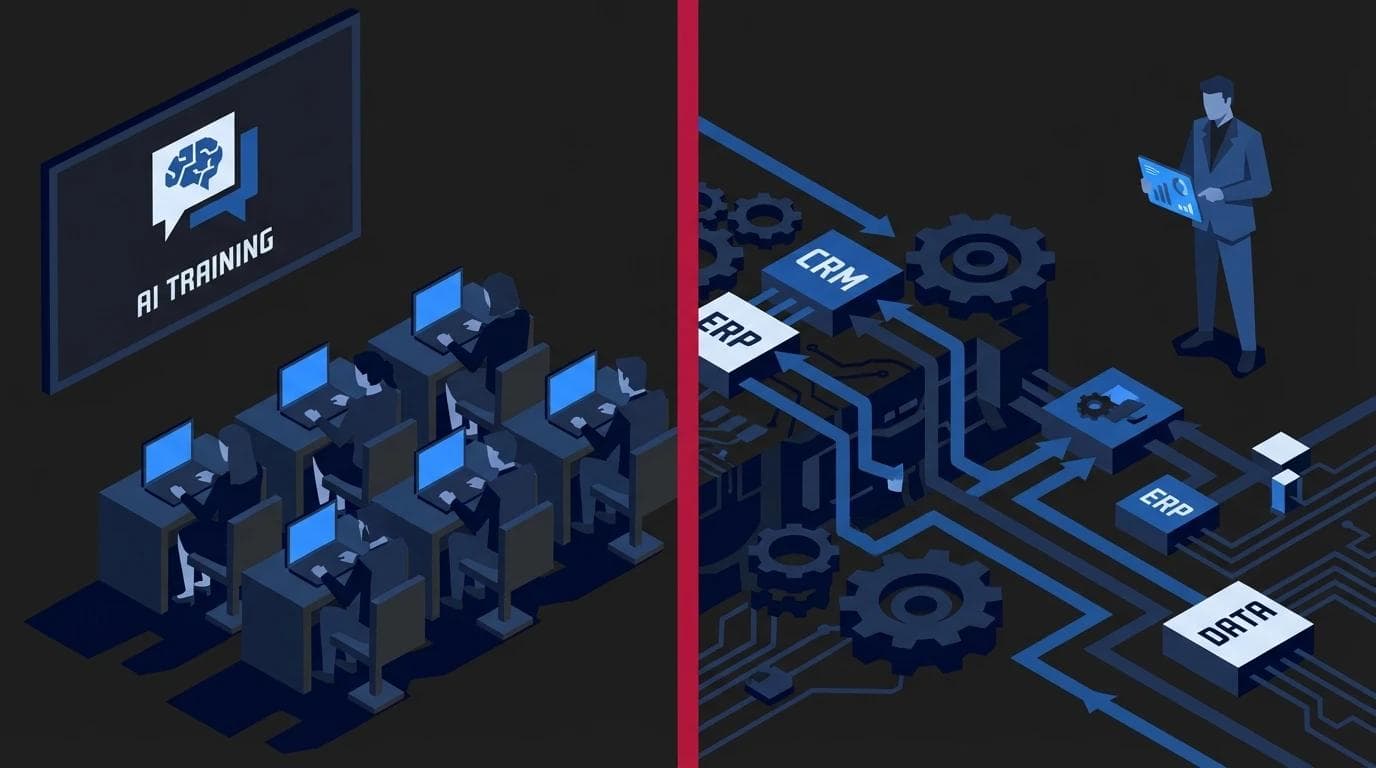
SUBJECT: Why Ready-Made Prompts Fail in Business - Guide

Prompt engineering for business - why ready-made prompt lists do not work in your company
> AI training in practice - why effective work with language models requires more than copying commands
AI training in practice is not a course on writing pretty essays, but a lesson in designing business logic using natural language. Effective work with advanced language models requires understanding that prompt engineering is, in reality, context engineering and decision frame management. Instead of memorizing ready-made formulas, the team must master the ability to map company processes into instructions that eliminate model hallucinations and ensure repeatable results. Only such an approach allows for a real AI implementation in the company that translates into a measurable increase in efficiency.
As engineers, we advise: stay far away from magic packs of 10,000 prompts for $20. Generic spells do not work in business because they lack the specific context of your organization. Real corporate-level prompt engineering is a skillful combination of the right words with a solidly organized company data structure. If you cannot define precise decision frames in a command, the model will start making things up for you, which is unacceptable in a professional environment. That is why our AI training for business emphasizes creating your own unique structures that solve specific operational problems.
Understanding technology also means being aware of risks. Uncontrolled use of publicly available tools can lead to leaks of sensitive information, which is why a key element of education is AI security in the company. We teach teams how to build secure work environments and when it is better to use closed APIs than public chats. For complex processes where prompts alone are not enough, dedicated applications integrated with language models may be necessary, allowing for full control over data flow.
Knowledge gained during workshops should immediately work for the company's results. By implementing AI tool training, we show how to create assistants that understand internal procedures and can, for example, autonomously pre-qualify leads or analyze technical documentation. This is a natural introduction to a deeper transformation, such as process automation, where artificial intelligence becomes one of the links in the digital chain of tasks. Effective training is one after which an employee stops asking AI about the weather and starts designing scripts that relieve them of two hours of boring work a day.
The foundation of a modern enterprise is a conscious team that knows that AI is a tool requiring engineering precision. It is worth familiarizing yourself with a comprehensive material, such as the AI training for companies - guide, to understand how to plan an educational path from the basics to advanced agentic systems. In a world of digital error and rapid technology adoption, organizations that build their own competencies in intelligence design win instead of copying commands from the internet.
> The trap of ready-made prompt lists - why copying web patterns fails in business
Copying ready-made prompt lists from the internet is the easiest way to produce generic, valueless content that, instead of supporting sales, builds distance between the brand and the audience. In the business world, where precision and uniqueness count, universal commands like "write me a LinkedIn post" or "create a marketing strategy" work like a template from a hardware store - they fit everywhere, but look good nowhere. Effective AI training for companies teaches that the true power of artificial intelligence lies not in knowing a thousand commands, but in the ability to design context and integrate models with real enterprise data.
The problem with generic prompts lies in the lack of so-called anchoring in your team's expert knowledge. A ready-made prompt from the internet "Write me a sales offer" will produce a beautiful, well-rounded offer from which the client will learn absolutely nothing specific about your product. Such text is a "statistical hallucination" - AI selects the most probable words that sound professional but are completely empty of substance. That is why professional AI training for business emphasizes creating your own internal instruction libraries.
Why do copied patterns fail in business practice?
- Lack of a unique brand voice (Tone of Voice) - public prompt lists do not know whether your company communicates in a technical, engineering way, or perhaps a casual and youthful one. The result will always be averaged and boring.
- Ignoring internal procedures - AI does not know your complaint handling standards, payment terms, or unique competitive advantages unless you learn to "inject" them correctly into the model.
- Risk of data leakage - mindlessly pasting data into public chats to fit a found prompt is a serious threat. It is worth knowing that AI security in the company starts with understanding how closed Enterprise models work.
- Lack of dynamic variables - business requires working on a living organism. A good prompt is actually a precise template that takes specific variables from a connected system (e.g., customer name, invoice value, unique complaint procedures of company X) and merges them into a highly specialized result.
For AI team efficiency to truly increase, a company must move from the level of a "chat user" to the level of a "process architect". This means that instead of looking for miracle lists on the web, you should build your own process automation, where language models are just one of the links, fed by specific facts from a CRM or ERP database. Only such an AI implementation in the company allows for generating content that actually sounds like it was written by your best expert, and not by an anonymous assistant from the other side of the world.
> Data architecture as the foundation of effective prompting
Most people perceive prompting as the art of writing magic spells that force artificial intelligence to work. In reality, a prompt is only an interface - the tip of the iceberg, under which lies the most important element: your data structure. Language models are not intelligent in the human sense of the word at all - they are brilliant probabilistic machines. If, in the implementation process, we provide the model with a clean and structured set of information, every prompt, even the simplest one, will produce a perfect result.
Real value flows from how data is simplified and presented to the machine. Our AI training for business emphasizes that a model has no right to make a mistake if the information foundation is solid. Instead of memorizing complicated commands, it is worth focusing on making your internal regulations, product descriptions, or operational processes not "rough notes", but an Enterprise-class knowledge base. This approach makes process automation fail-safe because AI operates on facts, not on guesses.
The role of business context in command design
Building a so-called Knowledge Base is the only way to eliminate AI hallucinations. When we teach teams how to implement own AI assistants in the company, we show that the model must have access to the specific context of your organization. Without this, even the most expensive system will generate generic answers that have no market value. AI must know exactly what your brand voice is, what your unique procedures are, and what distinguishes your offer from the competition.
Many managers make the mistake of trying to force public models to understand their business without providing them with raw data. As we notice during workshops where we conduct AI training for operations managers, the key to success is the selection and digitalization of resources. In situations where standard no-code tools do not allow for full control over the flow of information, the best solution is dedicated applications, because they do not have a technological ceiling and allow for safe connection of AI directly to company ERP or CRM systems.
All engineering effort consists of building this clean data foundation. If you want your team to stop fighting with tools and start really saving time, you must stop treating AI as an oracle and start perceiving it as a processor of your knowledge. This is the main topic we cover in our guide to AI training for companies, where we explain that technology is only as good as the data it works on.
> How to combine prompt engineering with business process automation
Combining prompt engineering with automation is the shortest path to achieving measurable ROI in any organization. In a traditional approach, an employee manually enters queries into a browser window, which, with a large scale of tasks, becomes inefficient and generates bottlenecks. True transformation begins when a perfectly developed, tested, and hallucination-resistant prompt is enclosed in the form of a maintenance-free script that runs in the background without human intervention.
Moving to this higher level of initiation is what we call silent, deep automation. Instead of manual ChatGPT handling, engineers design systems in which AI is called by specific events (triggers). Creating such intelligent workflows in tools like n8n allows for the construction of solutions in which AI becomes the operational "brain", and properly designed process automation performs the executive function. In such a model, a prompt is no longer just a request for text, but a precise instruction steering business logic.
A perfect example from engineering practice is the automatic handling of complaint emails. The system can, in a fraction of a second, attach a perfect prompt to each incoming message, analyze the customer's sentiment, extract key data from attachments, and prepare a draft response. This type of AI training in practice teaches teams how to replace "copy-paste" with headless scripts that integrate directly with the company's CRM or ERP system.
From a strategic perspective, understanding this mechanism is key for management. That is why modern AI training for managers puts such a large emphasis on data flow architecture, and not just on the literary quality of prompts. When standard SaaS tools stop being enough, the best solution becomes dedicated applications, which give full control over how prompt engineering cooperates with the company's internal knowledge base. Anyone planning comprehensive AI training for companies must take into account this technological leap - from simple conversation to autonomous AI agents realizing specific business goals.
> AI training for companies as a way to real team efficiency improvement
Simply providing employees with access to paid models is not a digital transformation, but only a cost. A real increase in efficiency starts where playing with a chatbot ends and solid AI training from scratch begins, which builds a foundation for the systemic implementation of artificial intelligence. Without proper substantive preparation, the team falls into the trap of so-called Shadow AI, using tools in a chaotic and often dangerous way for company data.
The key to success is unlearning the team's habit of treating the computer like a "magician" who is supposed to read our minds. At 01tech, we emphasize that AI training for business should be a two-day, hard training on live company documents. Teams learn the iron rules of formulating clear instructions, which makes the output they generate after the workshop drastically more effective and requires much fewer corrections.
During the workshops, we implement a specific communication protocol with models, which includes:
- Defining roles and tone - giving AI a specific expert persona, which stabilizes the response style and matches it to brand standards.
- Providing examples (few-shot prompting) - teaching AI the desired effect by providing model documents from the company's history.
- Setting clear prohibitions - defining the boundaries of AI creativity, which eliminates factual errors and undesirable phrases.
- Working on own data - analyzing real emails, reports, and files, which allows you to immediately implement knowledge in daily tasks.
Only such an approach allows you to understand how to measure ROI from AI training and avoid investing in technology that does not bring measurable time savings. Team education is the first step to building more advanced solutions, such as own AI assistants in the company, which can automatically manage the enterprise's knowledge base.
It is worth remembering that education is only the beginning of the road, which is covered more broadly in our AI training for companies - guide. Once employees master the art of prompting, the natural stage of evolution becomes process automation, eliminating repetitive activities and freeing up human potential for tasks requiring true creativity. A systemic approach to AI is an investment in a lasting competitive advantage, and not just a temporary fashion.
> Frequently asked questions about prompt engineering and AI training in practice
Implementing artificial intelligence in an organization raises many questions regarding both the technology itself and the way employees should interact with it. Entrepreneurs are looking for specific answers that will allow them to assess the validity of investing in team education. Below we have collected key issues that most often appear during process audits.
Is prompt engineering a skill that will quickly become obsolete?
Concerns that prompt engineering will disappear with the emergence of more intelligent models are only partially justified. Although algorithms are getting better at understanding imprecise commands, the heart of this discipline is not the knowledge of specific "magic formulas", but the ability to logically structure problems. Our AI training from scratch emphasizes analytical thinking and precise definition of business goals.
From an engineering perspective, it is worth noting that prompt engineering at the expert level (AI Engineering) is evolving towards building complex agentic systems. However, in daily office work, it is simply becoming a mandatory soft skill. Every person working on a computer today must be able to lead AI along a specific path of commands to avoid errors and model hallucinations. This is the foundation on which all modern AI training for companies is based.
How long does it take to teach a team to use AI effectively?
This process can be divided into two stages - intensive knowledge transfer and a period of building habits. Typical practical workshops last from 4 to 6 hours, during which employees learn techniques for working with models such as ChatGPT or Claude. However, for this knowledge not to evaporate, implementation support is key. A real change in efficiency occurs after about 2-4 weeks of regular work with assistants under the guidance of a mentor.
Effective AI training for managers teaches how to identify bottlenecks in the team and replace them with automation. Learning time also depends on the industry - in administration we focus on processing tables, while AI training for business in the sales sector emphasizes follow-up automation and customer needs analysis. This investment usually pays off instantly through the recovered work hours of specialists.
Why is free ChatGPT not enough for advanced prompting in a company?
Using free versions of language models in a corporate environment is a risky shortcut. The main argument against such a solution is AI security in the company - free tools often use the entered data to train their future versions. This creates a real risk of leaking company secrets or customers' personal data.
Paid models or Enterprise versions offer:
- Full data control - your information is not used for model learning.
- Larger context window - the system can analyze a hundred-page report or an entire documentation base at once without losing the thread.
- Access to API and integrations - which allows for the creation of more advanced solutions, such as process automation inside the company.
- Compliance with GDPR and the AI Act - which is necessary for entities operating on the European market.
Understanding the difference between a public chat and a professional work environment is the first step realized by our ChatGPT training for business. Thanks to this, the team learns not only "how to ask", but above all "where and how safely" to process sensitive data.